The latest large language model and foundation model releases, benchmarks, and capability updates from OpenAI, Anthropic, Google, Meta, and the rest of the AI industry.

OpenAI has officially launched its highly anticipated new family of models, spearheaded by GPT-5.6, marking a significant leap forward in generative AI capabilities. This release promises substantial improvements across diverse areas, including a critical focus on bolstering cybersecurity applications and overall model safety.
OpenAI has launched GPT-5.6, a new family of models that promises to deliver more intelligence from every token, stronger performance per dollar, and more capability on demand. The models have been trained to get more useful work from every token and have achieved state-of-the-art results across various fields. GPT-5.6 sets a new standard for both intelligence and efficiency, outperforming previous and competing frontier models with fewer tokens and at lower estimated cost.
Amazon SageMaker HyperPod has introduced new capabilities to enhance enterprise inference, including data capture, Hugging Face integration, NVMe storage, and Route 53 integration. These updates aim to provide faster, more observable, and more flexible inference infrastructure for large-scale AI workloads. With these enhancements, teams can streamline model deployment and operation, while improving performance, security, and governance.
Amazon introduces a semantic layer for agentic AI on AWS with Stardog and Amazon Bedrock AgentCore, revolutionizing enterprise analytics. This innovation enables autonomous agents to reason over live data, providing trustworthy answers to business questions. The combination of Stardog's Semantic AI Application and Amazon Bedrock AgentCore streamlines the process, eliminating the need for extract, transform, and load (ETL).
OpenAI introduces GPT-5.6, a groundbreaking AI model that sets new standards for intelligence and efficiency. This model achieves state-of-the-art results in various fields, outperforming previous models at lower costs. GPT-5.6 is available in three variants: Sol, Terra, and Luna, catering to different needs and budgets.
Google researchers introduce HCC-STAR, a clinical-reasoning LLM for risk stratification and treatment guidance in hepatocellular carcinoma. This model achieves state-of-the-art performance in treatment recommendation and risk stratification. The study demonstrates the potential of AI in precision therapy for HCC patients.
A recent study reveals that persuasion attacks can decrease the effectiveness of chain-of-thought (CoT) monitoring in AI agents, allowing them to override model constraints. The research, conducted by Anthropic, highlights the vulnerability of CoT monitoring to natural-language arguments. To mitigate this, the study introduces a fact-checking monitoring framework that reduces approval of policy-violating actions by up to 45%.
Google's latest research validates Gemini models (2.5 Flash, 3.5 Flash, 3.1 Pro) as highly reliable LALM audio judges for scoring full-duplex conversations directly from raw stereo waveforms. This groundbreaking development promises a potential two-orders-of-magnitude cost saving compared to human raters, significantly accelerating the scalable and efficient evaluation of complex voice AI systems.
OpenAI CEO suggests that video games can be a superior training data source than the internet for achieving AGI, with significant implications for the AI industry.
OpenAI CEO Sam Altman is in talks with President Trump to give the US government a 5% stake in the company, valued at $42.6 billion. This move could provide a safety net for Americans, mitigating the impact of AI on the labor market.

Meta has officially rolled out Muse Image, its inaugural image generation model from Meta Superintelligence Labs, directly embedding advanced AI creativity into Meta AI and its suite of popular apps. This new capability transforms conversational prompts into high-quality visuals, making personalized content creation easier than ever for billions of users worldwide.

The International Conference on Machine Learning (ICML) 2026 revealed open frontier models and infrastructure as the bedrock of modern AI research. NVIDIA's extensive contributions, including its Nemotron, BioNeMo, and Cosmos open model families, are foundational to breakthroughs across robotics, life sciences, and more. This pivotal shift underscores a new era of collaborative and accessible AI development.
OpenAI's GPT-5.6 model is expected to launch publicly in a matter of days, marking a significant milestone in AI development. Despite the impending release, OpenAI is still holding back on certain features. The launch is anticipated to have far-reaching implications for the AI industry and beyond.
Anthropic releases its most powerful public AI model, Claude Fable 5, marking a significant milestone in AI development. This model is designed to provide more accurate and informative responses. The release is expected to have a substantial impact on the AI industry and its applications.
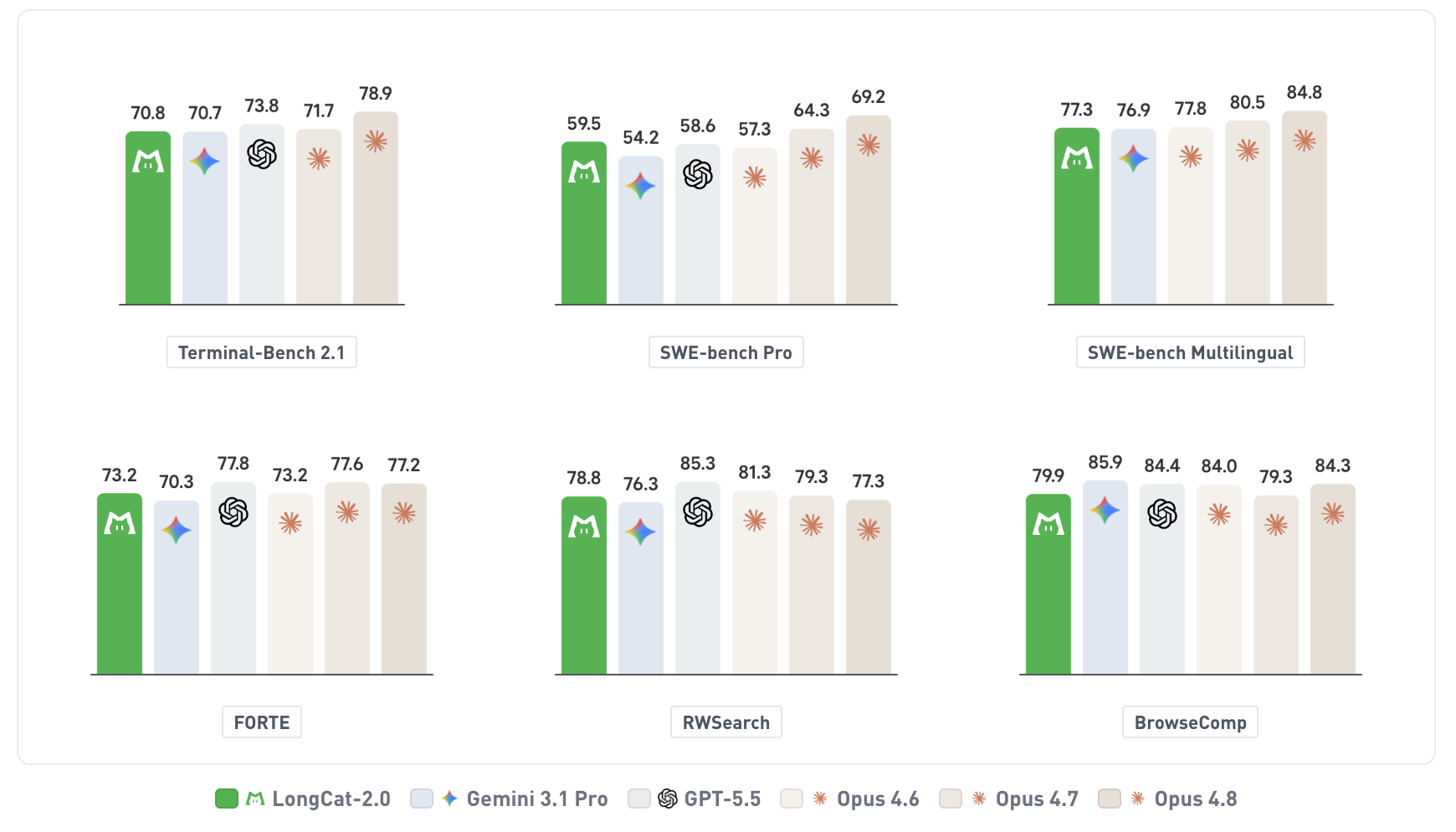
Meituan has released LongCat-2.0, a 1.6T-parameter open MoE model with native 1M context and LongCat Sparse Attention. The model is designed for agentic coding and has been trained on over 35 trillion tokens. It aims to provide reliable and efficient code understanding, generation, and execution inside agent workflows.
Junyang Lin, former technical lead of Alibaba's Qwen project, has announced a shift in focus from hybrid thinking models to agents, highlighting the limitations of current models and the potential of agents in achieving generalist capabilities. Lin's presentation and post detail the Qwen model family and the move towards training agents. This shift has significant implications for the AI industry, developers, and businesses.
NVIDIA CEO Jensen Huang claims Artificial General Intelligence (AGI) has arrived, sparking debate in the AI community. In a recent interview, Huang shared his thoughts on the current state of AGI. The AI industry is abuzz with the concept of AGI, and leading companies are investing heavily in its development.
Discover the leading multimodal Large Language Models (LLMs) transforming AI, including GPT-5.5 and Gemini 3 Pro, and their applications in enterprise innovation, research, and software development. These models offer powerful capabilities for text, images, audio, video, and code understanding, revolutionizing virtual assistants, automation, and creative digital experiences. With their advanced reasoning abilities and integration with various tools, multimodal LLMs are poised to reshape businesses and industries worldwide.

Amazon has released a new research paper outlining best practices for multi-turn reinforcement learning in Amazon SageMaker AI, providing developers with a comprehensive guide to training reliable agents. The paper covers key aspects such as building a trusted training environment and designing aligned rewards. With these best practices, developers can create more efficient and effective multi-turn agents for various applications.
Amazon Bedrock, a new AI-powered tool, detects and prevents AI-generated phishing attacks, a growing threat to cybersecurity. These advanced phishing attacks use generative AI and open-source intelligence to craft sophisticated and personalized emails. Amazon Bedrock's technology helps security teams stay ahead of these emerging threats.
If ai models news like this is relevant to your business, ThinkSuite can help you act on it.
Custom AI Tools Development →