NVIDIA & Dyania Health Deploy On-Premise AI for Patient Care
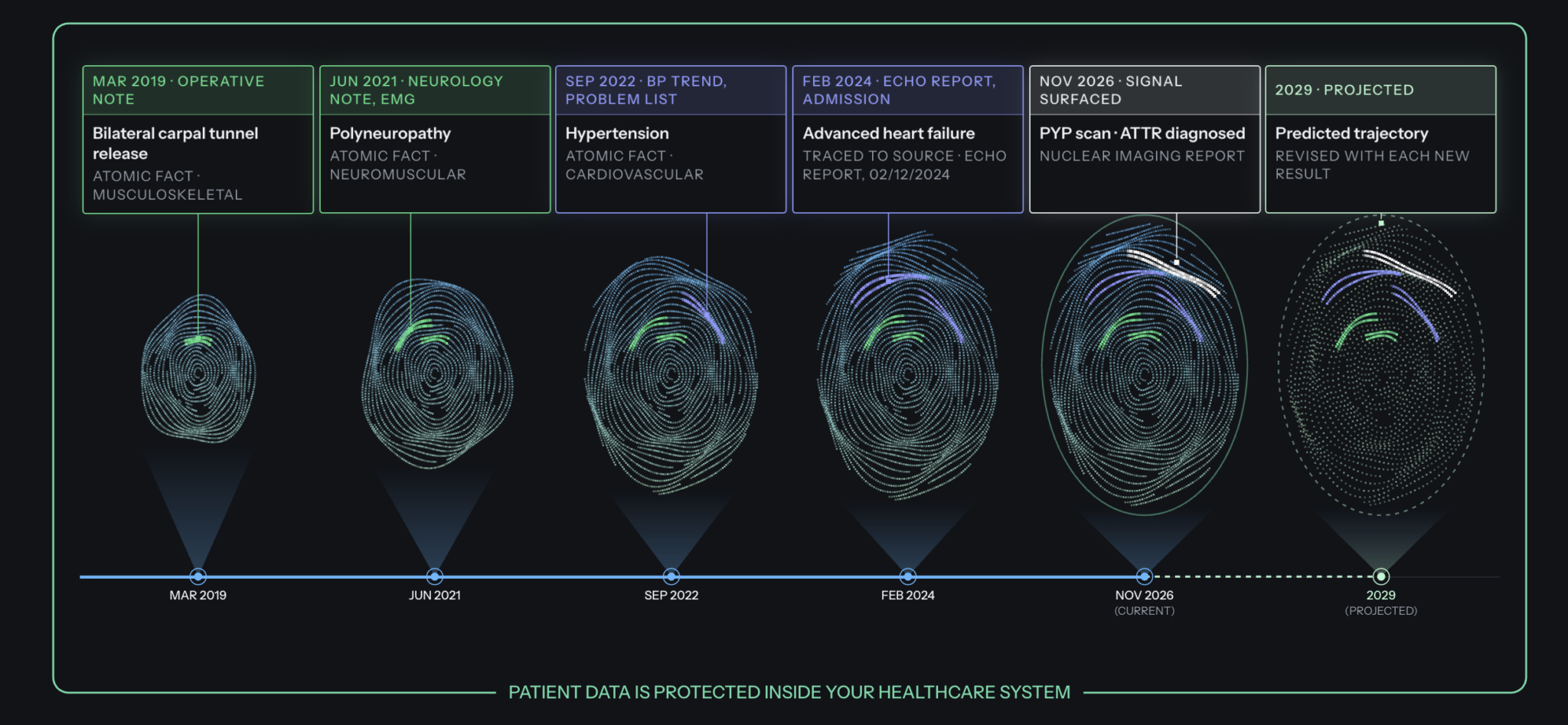
Dyania Health uses NVIDIA-accelerated computing to run Synapsis AI, a clinical reasoning engine that processes unstructured hospital records within secure firewalls. This approach helps clinicians analyze patient histories faster while keeping health data completely private.
- Dyania Health developed Synapsis AI, a clinical reasoning engine running on NVIDIA-accelerated hardware.
- Operates entirely inside health system firewalls to ensure 100% data privacy and security.
- Processes years of unstructured clinical notes, lab results, and pathology reads automatically.
- Surfaces traceable clinical signals while clinicians retain full decision-making control.
- Demonstrates the growing trend of localized enterprise AI deployments in highly regulated industries.
Dyania Health has partnered with NVIDIA to deploy Synapsis AI, a clinical reasoning engine built to analyze decades of unstructured patient records directly behind a health system's firewall. Powered by NVIDIA-accelerated compute, the system automates chart reviews, allowing clinical teams to surface actionable medical insights faster while keeping sensitive health data completely secure.
How Is NVIDIA and Dyania Health Accelerating Clinical AI?
Hospitals accumulate millions of unstructured files over decades, including physician notes, operative reports, pathology reads, and discharge summaries. Synthesizing this vast volume of unstructured data manually requires hours of chart review, creating bottlenecks for clinical teams and delaying patient care.
To address this challenge, Dyania Health developed Synapsis AI. Running on NVIDIA-accelerated computing infrastructure, Synapsis AI operates as a clinical reasoning engine. It scans historical records, connects findings across years of care notes, and highlights critical patient signals for care teams to review. By providing an automated yet clinician-guided workflow, the platform ensures that doctors remain the ultimate decision-makers while drastically reducing manual administrative workload.
How Does Dyania Health's Synapsis AI Work Inside Hospital Firewalls?
Data security and regulatory compliance are critical considerations when integrating artificial intelligence into healthcare environments. Synapsis AI addresses these requirements by operating entirely inside the health system's localized security perimeter.
Key operational features of Synapsis AI include:
- On-Premise Processing: The entire suite of patient records is processed locally on NVIDIA hardware, ensuring data never leaves the hospital firewall or transfers to external cloud environments.
- Traceable Clinical Signals: Every output produced by the reasoning engine links directly back to its source in the clinical record, allowing doctors to audit the underlying medical evidence instantly.
- Assistive Human-in-the-Loop Workflow: The AI platform acts strictly as an intelligence booster. Clinicians evaluate the evidence flagged by Synapsis AI before taking any diagnostic or therapeutic action.
This architecture enables healthcare organizations to deploy custom AI tools safely, striking an optimal balance between automated data extraction and robust compliance.
Why Is On-Premise Accelerated Compute Critical for Healthcare AI?
Processing unstructured medical text at scale requires specialized compute capabilities. NVIDIA acceleration provides the foundational computational bandwidth necessary to execute complex language models and reasoning algorithms on dense medical datasets without suffering performance latency.
Furthermore, running localized generative AI systems eliminates third-party cloud data privacy concerns. Healthcare providers can process highly sensitive patient health information while adhering to strict regulatory frameworks such as HIPAA. As industry demand grows for domain-specific intelligence, localized compute setups will become the standard deployment model for highly regulated sectors.
What this means for your business
The collaboration between NVIDIA and Dyania Health highlights a major enterprise trend: organizations in regulated sectors need secure, localized AI solutions that automate complex workflows without exposing sensitive data. For modern enterprises, deploying on-premise LLMs and tailored domain engines is no longer optional—it is essential for operational efficiency and compliance.
At ThinkSuite, we help organizations navigate this shift by offering end-to-end custom AI tools development designed to handle proprietary and sensitive internal data securely. Whether your business requires advanced custom software development to build scalable internal tools or strategic business strategy consulting to map out your AI governance framework, our team ensures your technology infrastructure is optimized for performance and safety.
By implementing customized reasoning models and private workflow automations, companies can streamline data-heavy processes, reduce overhead, and empower teams to make faster, evidence-based decisions. ThinkSuite partners with executive teams to evaluate infrastructure requirements, select optimal hardware configurations, and deploy production-ready AI tools tailored to your industry's specific needs.
Frequently Asked Questions
How does Dyania Health use NVIDIA compute to improve patient outcomes?
Dyania Health utilizes NVIDIA-accelerated compute to run its Synapsis AI reasoning engine behind hospital firewalls. This allows care teams to analyze years of unstructured medical records in seconds, identifying critical patient insights while ensuring data remains strictly private.
How can enterprise businesses apply on-premise AI models like Dyania Health's?
Businesses in data-sensitive industries can implement custom AI tools development and custom software architectures to process proprietary data on-premise. By consulting with specialized partners like ThinkSuite for business strategy consulting, companies can design secure, compliant AI systems that automate routine data analysis without exposing confidential records.
Why is human-in-the-loop design essential for enterprise AI tools?
Human-in-the-loop design ensures that AI systems serve as assistive intelligence rather than autonomous decision-makers. In high-stakes environments like healthcare, legal, or finance, expert oversight guarantees accuracy, accountability, and regulatory adherence.
Why it matters
This breakthrough demonstrates how domain-specific AI engines can solve complex data processing challenges without sacrificing data privacy. By processing unstructured patient histories directly within hospital firewalls, Dyania Health and NVIDIA provide a model for enterprise AI adoption in highly regulated sectors. For technology leaders, this shift highlights the importance of localized compute and privacy-first AI architectures. Organizations no longer need to compromise between data security and advanced automation. Moreover, the human-in-the-loop framework implemented by Dyania Health ensures that AI amplifies human expertise rather than replacing critical clinical judgment, setting a standard for responsible deployment across industries.
Market impact
The successful deployment of localized clinical reasoning engines reinforces NVIDIA's dominance in enterprise AI infrastructure beyond standard cloud data centers. Hardware-accelerated on-premise solutions are gaining momentum as enterprises seek private alternatives to third-party public cloud endpoints. Competitors in clinical tech and cloud service provision will increasingly need to offer hybrid or fully localized edge deployments to satisfy strict data governance mandates. Investment into domain-specific LLMs and specialized hardware integrations will likely accelerate as enterprises move from pilot projects to core operational integrations.
Developer impact
Developers working in enterprise and healthcare settings must prioritize privacy-by-design architectures. Integrating models locally requires deep understanding of accelerated compute optimization, low-latency inference, and secure local data pipelines. Building verifiable reference links—where AI outputs map directly back to unstructured source files—is becoming a mandatory capability for enterprise toolmakers. Engineers will also see increased demand for hybrid deployment patterns, combining local compute nodes with localized vector databases and audit logging systems.
What comes next
In 30 days, expect more health systems to announce trials of localized reasoning models for clinical trial matching and chart reviews. Within 90 days, hardware providers like NVIDIA will release expanded reference architectures tailored for enterprise on-premise AI deployments. By 180 days, non-healthcare sectors such as legal and financial services will widely adopt firewall-enclosed clinical and domain reasoning tools to process sensitive documents safely.
The collaboration between Dyania Health and NVIDIA underscores the shift toward localized, privacy-preserving artificial intelligence in healthcare and enterprise sectors. Unstructured data has long been a major bottleneck for healthcare systems; converting raw notes into actionable insights manually consumes vast clinical resources. By building Synapsis AI to run on NVIDIA's accelerated compute hardware behind local firewalls, Dyania Health addresses two critical friction points simultaneously: computational scale and regulatory compliance. The ability to link every generated insight directly back to source documents provides necessary auditability for clinical validation. Looking forward, this architectural approach will become standard not only in healthcare but across financial services, legal tech, and defense—industries where data mobility is strictly constrained by law or policy.
ThinkSuite AI analysis
Frequently asked questions
How does Dyania Health use NVIDIA compute to improve patient outcomes?
Dyania Health utilizes NVIDIA-accelerated compute to run its Synapsis AI reasoning engine behind hospital firewalls. This allows care teams to analyze years of unstructured medical records in seconds, identifying critical patient insights while ensuring data remains strictly private.
How can enterprise businesses apply on-premise AI models like Dyania Health's?
Businesses in data-sensitive industries can implement custom AI tools development and custom software architectures to process proprietary data on-premise. By consulting with specialized partners like ThinkSuite for business strategy consulting, companies can design secure, compliant AI systems that automate routine data analysis without exposing confidential records.
Why is human-in-the-loop design essential for enterprise AI tools?
Human-in-the-loop design ensures that AI systems serve as assistive intelligence rather than autonomous decision-makers. In high-stakes environments like healthcare, legal, or finance, expert oversight guarantees accuracy, accountability, and regulatory adherence.
Go deeper
All Opportunities (3)
TrialMatch AI
medium competitionAn AI-driven platform that scans EHRs, clinical trial protocols, and patient preferences to match eligible patients with trials in real time. It automates eligibility checks and provides instant notifications to recruiters and patients.
RadiologyAI Assistant
high competitionA cloud-based AI tool that preprocesses imaging studies, highlights potential findings, and generates preliminary radiology reports for review. It integrates seamlessly with existing PACS systems to accelerate workflow.
HomeCare AI Navigator
medium competitionA mobile app that monitors patient vitals via wearables, predicts deterioration, and triages patients to the appropriate care setting. It offers real-time alerts to home health agencies and clinicians.
Also available in:EspañolFrançais
Sources
NVIDIA Blog ↗More on NVIDIA

NVIDIA Board Reportedly Considers Ousting CEO Jensen Huang: Market & AI Impact
Reports indicate NVIDIA's board is considering the departure of longtime CEO Jensen Huang following personal conduct allegations and internal governance reviews. The news triggered an 8% drop in NVIDIA stock, raising critical questions for enterprise AI roadmaps reliant on GPU infrastructure.

Amazon SageMaker HyperPod Adds Silent Data Corruption Detection
AWS and NVIDIA have unveiled a automated validation framework to detect and recover from silent data corruption on Amazon SageMaker HyperPod clusters. The three PyTorch-level checks protect large-scale AI training runs from invisible GPU errors that waste compute and degrade model quality.

Nvidia Open-Sources Flora: 125x Cheaper Robot Video Labeling Shakes AI Industry
Nvidia released Flora, an open‑source video‑labeling engine that claims to cut annotation costs by up to 125× compared with GPT‑6 Astra. The move promises faster robot learning and broader access for developers and enterprises.