NVIDIA SC26 Keynote: Nemotron for Science and AI Agents Unveiled
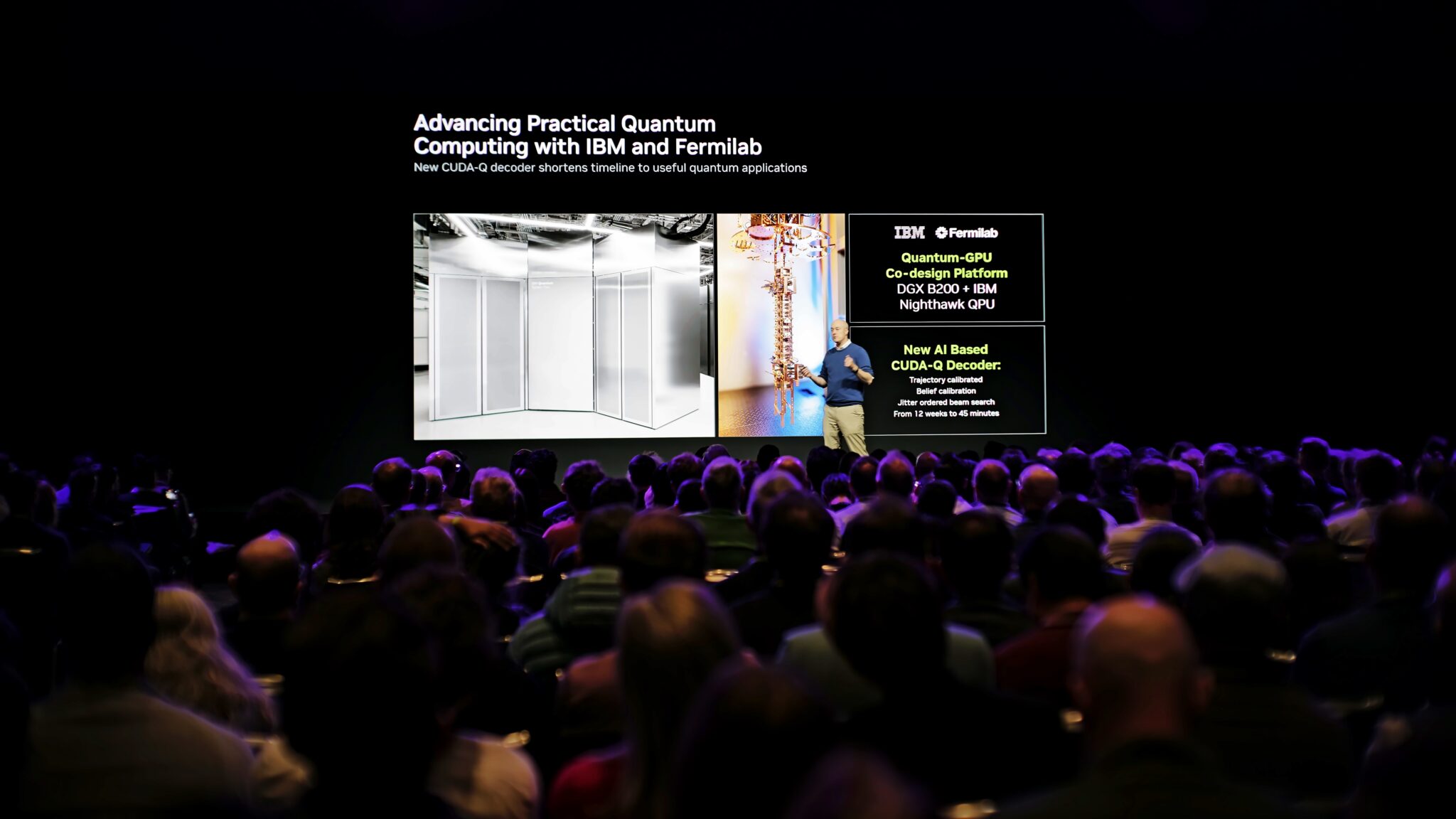
NVIDIA vice president Ian Buck opened SC26 in Chicago by introducing Nemotron for Science, the Rubin HPC GPU, and autonomous AI agents designed to plan experiments, repair setups, and run complex simulations on enterprise hardware.
- NVIDIA introduced Nemotron for Science, integrating the Nemotron 3.5 Super VL open model with open chemistry datasets and domain recipes.
- Announced the next-generation Rubin HPC GPU and expanded Vera CPU platform to power agentic supercomputing.
- Demonstrated autonomous AI agents that plan experiments, run simulations, and fix broken code setups (e.g., KTH's GROMACS agent fixing 81% of broken cases).
- Emphasized complete data sovereignty, allowing organizations to run open agents locally on DGX Spark workstations or enterprise supercomputers.
- Detailed a new quantum computing collaboration alongside IBM and Fermi National Accelerator Laboratory.
NVIDIA kicked off its week at the SC26 supercomputing conference in Chicago with a major keynote by Ian Buck, Vice President of Hyperscale and High-Performance Computing. The company announced Nemotron for Science, the Rubin HPC GPU, an expanded Vera CPU platform, and autonomous AI agents engineered to plan and execute scientific workflows on local systems.
What Did NVIDIA Announce at SC26?
Twenty years after introducing CUDA at SC06, NVIDIA used its SC26 keynote to signal a paradigm shift from traditional simulation to agentic high-performance computing. At the center of the announcements is Nemotron for Science, an open framework designed to bring domain-specific AI agents into research labs and enterprise R&D departments.
Nemotron for Science combines NVIDIA’s Nemotron 3.5 Super VL open model with specialized open chemistry datasets and post-training recipes tailored for life sciences and chemical engineering. Rather than relying entirely on centralized cloud APIs, researchers can run these agents locally across hardware ranging from DGX Spark workstations to full-scale supercomputers. During the address, Buck highlighted how an agent built with the toolkit at Argonne National Laboratory took a single natural-language prompt, formulated hypotheses, selected simulation parameters, and identified two novel binding sites autonomously.
Buck also announced the Rubin HPC GPU architecture and an expanded Vera CPU platform, extending NVIDIA’s hardware roadmap for high-performance workloads. Additionally, NVIDIA detailed a quantum computing collaboration with IBM and Fermi National Accelerator Laboratory to integrate quantum processors alongside classical simulation and artificial intelligence.
How Are Autonomous AI Agents Transforming Scientific Workflows?
While traditional simulation remains the foundation of high-performance computing, the integration of autonomous agents introduces an intelligent software layer capable of managing complex operations without manual human intervention. Buck demonstrated several real-world implementations currently active in production research:
- Automated Troubleshooting with GROMACS: An agent developed by researchers at the KTH Royal Institute of Technology automatically diagnoses and repairs broken GROMACS molecular dynamics setup scripts. In an overnight trial on a single DGX Spark system, the agent autonomously resolved 81% of failing test cases.
- Astronomical Data Analysis at SETI: The SETI Institute is leveraging domain-specific agents at the Allen Telescope Array to filter noise, configure backend processing pipelines, and evaluate signal anomalies in real time.
- Autonomous Drug Discovery: Enterprise chemical and pharmaceutical teams are using custom agent workflows to bridge natural language instructions with low-level simulation libraries, accelerating candidate screening while retaining complete data privacy.
Crucially, NVIDIA stressed the importance of data sovereignty. By deploying open models locally on enterprise hardware, organizations maintain complete control over proprietary datasets, custom fine-tuning weights, and scientific intellectual property.
What Are the Technical Specifications of Nemotron for Science?
Nemotron for Science is built upon NVIDIA’s open-weights foundation, enabling deep customization across enterprise IT environments. Key technical components include:
- Nemotron 3.5 Super VL Backbone: A multimodal architecture capable of processing complex molecular structures, scientific diagrams, code repositories, and unstructured scientific literature simultaneously.
- Open Datasets and Recipes: Pre-packaged training pipelines and specialized datasets covering organic chemistry, materials science, and structural biology.
- Local Execution Capability: Native support for local deployment on DGX Spark workstations, enterprise GPU clusters, and hybrid HPC infrastructure without external data transmission.
- CUDA-X Integration: Direct integration with over 1,000 accelerated CUDA-X libraries, allowing agents to write, compile, execute, and verify GPU-accelerated code autonomously.
Frequently Asked Questions About NVIDIA SC26 and AI Agents
What this means for your business
NVIDIA's announcements at SC26 confirm that enterprise software is shifting from passive AI assistance to fully autonomous execution. Businesses across biotechnology, manufacturing, and technology can no longer rely on generic chat interfaces; they need specialized custom AI tools development that integrate directly into proprietary databases, legacy software stacks, and internal workflows.
At ThinkSuite, we help organizations translate cutting-edge agentic architectures into operational advantage. Whether your team requires tailored AI automation to replace repetitive operational tasks or an overarching AI strategy to evaluate hardware investments and model deployment, our team builds production-ready systems designed around security and data ownership.
By leveraging open-weights models and specialized domain integrations, ThinkSuite enables enterprises to deploy secure agents that operate directly on company infrastructure. From custom model fine-tuning to building specialized multi-agent orchestrators, we bridge the gap between high-level hardware innovations and practical enterprise execution. To explore how autonomous agents can transform your operations, speak with our team for a custom proposal.
Why it matters
NVIDIA’s SC26 address marks a fundamental shift in how high-performance computing and enterprise R&D operate. By combining open multimodal foundation models with autonomous agents, NVIDIA is moving computing beyond manual script execution toward goal-oriented problem solving. Researchers and engineers can now issue natural-language objectives while agents independently manage code generation, setup verification, and simulation runs. For enterprise leaders, this transition underscores the growing importance of local execution and open-weights models. As proprietary datasets become the core differentiator for R&D organizations, the ability to run state-of-the-art agentic workflows on local DGX workstations or private cloud clusters ensures complete data privacy and intellectual property control without sacrificing state-of-the-art AI capability. Furthermore, the integration of classical simulation, agentic AI, and quantum research indicates that future software architectures will be hybrid. Technical teams that adopt domain-specific agents today will dramatically compress product development cycles, while those relying solely on manual operational pipelines risk falling behind in execution speed.
Market impact
NVIDIA's focus on agentic supercomputing accelerates hardware demand for local enterprise AI infrastructure, such as workstation-class GPU clusters and edge-based DGX systems. Cloud infrastructure providers will face rising demand for open-weights hosting, while specialized enterprise AI vendors will see expanded opportunities building custom domain agents for life sciences, materials discovery, and industrial engineering. In addition, closed LLM vendors may face competitive pressure in specialized technical verticals as enterprise clients gravitate toward open-weights models like Nemotron 3.5 Super VL, which can be fine-tuned locally without exposing sensitive proprietary code or experimental data to third-party APIs.
Developer impact
For developers and software engineers, NVIDIA's SC26 announcements emphasize the rise of agentic software architecture. Technical teams will need to focus on building robust verification frameworks, tool-use abstractions, and integration pipelines that allow LLMs to safely invoke terminal commands, run simulation packages, and evaluate execution logs. Developers will also benefit from expanded open-source post-training recipes and dataset libraries provided under the Nemotron ecosystem, making it significantly easier to customize domain-specific agents for niche enterprise applications without building foundation models from scratch.
What comes next
Over the next 30 days, expect developer communities to benchmark Nemotron 3.5 Super VL against leading open models for code generation and scientific tool usage. Within 90 days, enterprise R&D labs will launch pilot projects running local agents on DGX Spark workstations for internal automation. By 180 days, autonomous setup-repair and simulation-planning agents will become standard components of enterprise high-performance computing pipelines.
Ian Buck’s SC26 address highlights NVIDIA's long-term strategy of capturing both the hardware layer (Rubin HPC GPU, Vera CPU) and the software orchestration layer (CUDA-X libraries, Nemotron for Science). By positioning AI agents as the primary interface for scientific supercomputing, NVIDIA expands its total addressable market from traditional simulation experts to enterprise researchers who require natural language interaction with high-performance computing systems. The real breakthrough lies in agentic resilience. The KTH GROMACS example—where an agent repaired 81% of failing setup scripts overnight—demonstrates that agents are moving from simple text generation to closed-loop operational execution. The primary challenge for enterprise adoption will not be raw hardware performance, but governance and validation: establishing precise sandboxes and verification checks to ensure autonomous agents do not hallucinate scientific parameters or run unauthorized compute cycles. From an industry perspective, NVIDIA’s emphasis on open chemistry datasets and open-weights models directly challenges closed API models. Organizations in regulated industries such as healthcare, pharmaceuticals, and advanced manufacturing will increasingly prefer local open-weights deployments to preserve absolute sovereignty over their research pipelines.
ThinkSuite AI analysis
Frequently asked questions
What is Nemotron for Science announced by NVIDIA at SC26?
Nemotron for Science is an open framework unveiled by NVIDIA at SC26 that combines the Nemotron 3.5 Super VL open model with open chemistry datasets and domain-specific post-training recipes. It allows scientific and enterprise teams to deploy autonomous AI agents locally on DGX workstations or supercomputers to plan experiments, write code, and analyze simulation results.
How do autonomous AI agents improve high-performance scientific computing?
Autonomous AI agents translate natural-language instructions into concrete computational workflows. They can automatically fix broken setup scripts, formulate hypotheses, select simulation parameters, and execute low-level CUDA-X code, allowing researchers to automate complex technical tasks while maintaining data privacy on local hardware.
How can my business apply NVIDIA's AI agent developments to our operations?
Your business can apply these developments by engaging ThinkSuite for custom AI tools development to build specialized autonomous agents tailored to your specific workflows. ThinkSuite helps enterprises deploy secure AI automation solutions on local or private infrastructure, transforming manual technical processes into streamlined automated operations.
Go deeper
NVIDIA’s announcement unlocks a wave of AI‑powered scientific workflow platforms, hybrid quantum‑classical simulation tools, and automated lab automation. These opportunities promise high TAMs, recurring revenue models, and strong alignment with NVIDIA’s hardware ecosystem, making them attractive for venture investment.
SciAgentOps
A cloud‑native platform that lets researchers design, schedule, and execute AI‑driven experimental workflows across local HPC clusters and cloud resources. It integrates NVIDIA’s Nemotron for Science to auto‑generate code, run simulations, and validate results in one unified UI.
All Opportunities (6)
SciAgentOps
medium competitionA cloud‑native platform that lets researchers design, schedule, and execute AI‑driven experimental workflows across local HPC clusters and cloud resources. It integrates NVIDIA’s Nemotron for Science to auto‑generate code, run simulations, and validate results in one unified UI.
QuantumSimBridge
low competitionA middleware that maps high‑level AI models onto quantum hardware via IBM Qiskit, enabling hybrid classical‑quantum simulation workflows for material science and drug discovery. It offers a drag‑and‑drop interface for experiment design and real‑time result interpretation.
HPC-AI Ops Suite
high competitionAn integrated monitoring and optimization stack that automatically tunes Vera CPU workloads with AI, balancing compute, memory, and energy usage on NVIDIA’s expanded CPU platform. It provides predictive scaling and anomaly detection for large‑scale simulations.
AutoExperiment Designer
medium competitionA web app that uses GPT‑style models to draft experimental protocols, generate code snippets, and auto‑validate results against user‑defined criteria. It supports plug‑ins for NVIDIA’s Rubin HPC GPU and Vera CPUs for seamless execution.
Quantum‑AI Integration Hub
low competitionA marketplace API that lets AI developers plug their models into quantum backends via a unified SDK, enabling hybrid inference pipelines. It abstracts device specifics and offers cost‑optimization strategies.
AI‑Driven Lab Automation
high competitionRobotic control software that interprets AI experiment plans and orchestrates physical lab equipment (pipettes, incubators) using NVIDIA’s AI agents. It provides real‑time monitoring and adaptive protocol adjustment.
💰 Investment Angles
- 1. Leverages NVIDIA’s cutting‑edge AI agent tech and HPC ecosystem, creating a high‑barrier entry point for scientific workflow automation.
- 2. Addresses a rapidly expanding market of AI‑augmented research with recurring subscription revenue and high customer lock‑in.
- 3. Enables cross‑industry adoption (academia, pharma, materials science) and potential upsell to NVIDIA’s GPU/HPC hardware sales.
⚠️ Threatened Startups
- Labguru
- Benchling
- Labster
- VASP
- SciPy
- DeepChem
👩💻 Emerging Job Roles
- AI Experiment Designer
- HPC‑Quantum Integration Engineer
- Scientific Workflow Automation Specialist
- AI‑Driven Lab Automation Engineer
Sources
NVIDIA Blog ↗More on NVIDIA
NVIDIA Leadership Rumors and Deep Tech Benchmarks: Key Takeaways
Recent reports highlight potential executive leadership shifts at NVIDIA as Jensen Huang considers a CEO return amidst regulatory scrutiny. Simultaneously, deep-tech research evaluates the timeline for transformative innovations in hardware, governance, and AI.

Should Jensen Huang Return as Nvidia CEO? Debate Split Grows
Following Jensen Huang's resignation from Nvidia amid regulatory scrutiny and personal controversies, over 158,000 tech leaders are rallying for his return. Meanwhile, US government officials demand a major corporate overhaul and answers regarding chip leaks to China.

Meituan Debuts 1.6T LongCat-2.5 Agent Model Built Without Nvidia GPUs
Chinese tech leader Meituan has released LongCat-2.5, a 1.6-trillion-parameter open-weights agent model trained entirely on domestic hardware without Nvidia chips. Capable of handling 1M context tokens and autonomous coding tasks, the model achieves near-parity with top Western AI models like Claude Opus 5.