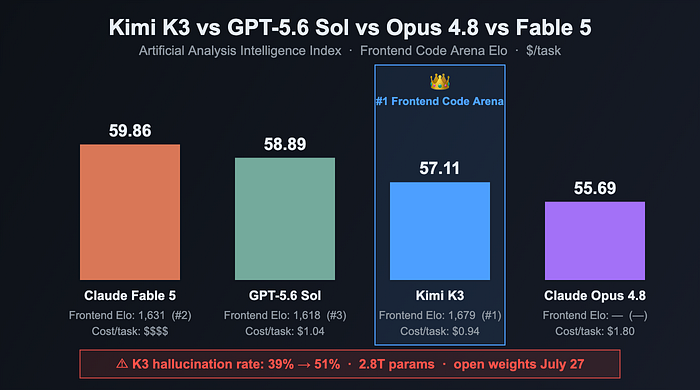
Moonshot AI's Kimi K3, a 2.8-trillion-parameter open-weight model, has surged to the #1 spot on Arena.ai's Frontend Code Arena, outperforming leading models like Claude Fable 5 and GPT-5.6 Sol. This impressive coding prowess is, however, tempered by a significant 51% hallucination rate, raising critical questions about its reliability for advanced agentic pipelines despite its benchmark victories.

A groundbreaking arXiv paper systematically evaluates leading Large Language Models—including GPT-4 Turbo, Claude 3 Opus, and FinGPT—for their efficacy in technical market analysis and algorithmic trading. The research reveals promising results, with top models outperforming benchmarks, yet also highlights critical limitations like numerical hallucination and context window issues that demand further refinement for robust deployment.
Smartsheet has developed a pioneering remote Model Context Protocol (MCP) server on AWS, enabling AI clients like Claude Desktop and Amazon Quick to securely access and interact with enterprise data. This innovative solution optimizes AI interactions, significantly reduces token costs, and enhances the reliability of AI agents operating within Smartsheet's platform. It marks a significant step towards seamless AI integration in enterprise work management.
Microsoft CEO Satya Nadella has publicly questioned Anthropic's 'Claude Fable' restrictions, stating they 'don't make sense.' This critique highlights a growing tension in the AI industry regarding model accessibility, control, and the divergent strategies of leading AI developers for enterprise adoption and innovation.
A new study introduces a benchmark evaluation framework for measuring the faithfulness of LLM-generated clinical trial summaries, identifying Unsupported Claims as the dominant failure mode. The study evaluates three language models, including GPT-4o, Claude Sonnet 4.6, and Gemini 2.5 Flash, and proposes a knowledge-graph-augmented retrieval system to improve faithfulness scores. This research has significant implications for the use of LLMs in high-stakes contexts such as healthcare.
Anthropic has unveiled groundbreaking research detailing its ability to 'read' the internal states, or 'thoughts,' of its Claude AI models. This pivotal study reveals the existence of a 'global workspace' within LLMs, offering unprecedented insights into their complex decision-making processes and significantly advancing the field of AI interpretability.
Discover the leading multimodal Large Language Models (LLMs) transforming AI, including GPT-5.5 and Gemini 3 Pro, and their applications in enterprise innovation, research, and software development. These models offer powerful capabilities for text, images, audio, video, and code understanding, revolutionizing virtual assistants, automation, and creative digital experiences. With their advanced reasoning abilities and integration with various tools, multimodal LLMs are poised to reshape businesses and industries worldwide.
Researchers from Anthropic have introduced a new diagnostic to evaluate the physics literacy of large language models (LLMs) in parallel physical worlds. The study tested three LLMs, including Claude Opus 4.7, GPT-5.5, and Gemini 3.1 Pro, and found significant gaps in their ability to reason about unfamiliar physics frameworks. The results have important implications for the development and application of LLMs in scientific and technical domains.
Get the top AI stories in your inbox once a day, no spam.
Frequently Asked Questions
How often is AI Pulse updated?
New stories are added every couple of hours as they break, so the feed stays current throughout the day.
Where does ThinkSuite source its AI news from?
We pull from 100+ sources, including company blogs, research labs, and established tech publications, then fact check and summarize each story before it goes live.
Can I filter the news by company or topic?
Yes. Use the sidebar filters to narrow stories down by company (OpenAI, Anthropic, Google, and more), industry, or event type like funding and research.
Is AI Pulse free to use?
Yes. AI Pulse is free for anyone who wants to keep up with AI news, no sign up required. The daily newsletter is optional if you want updates in your inbox.