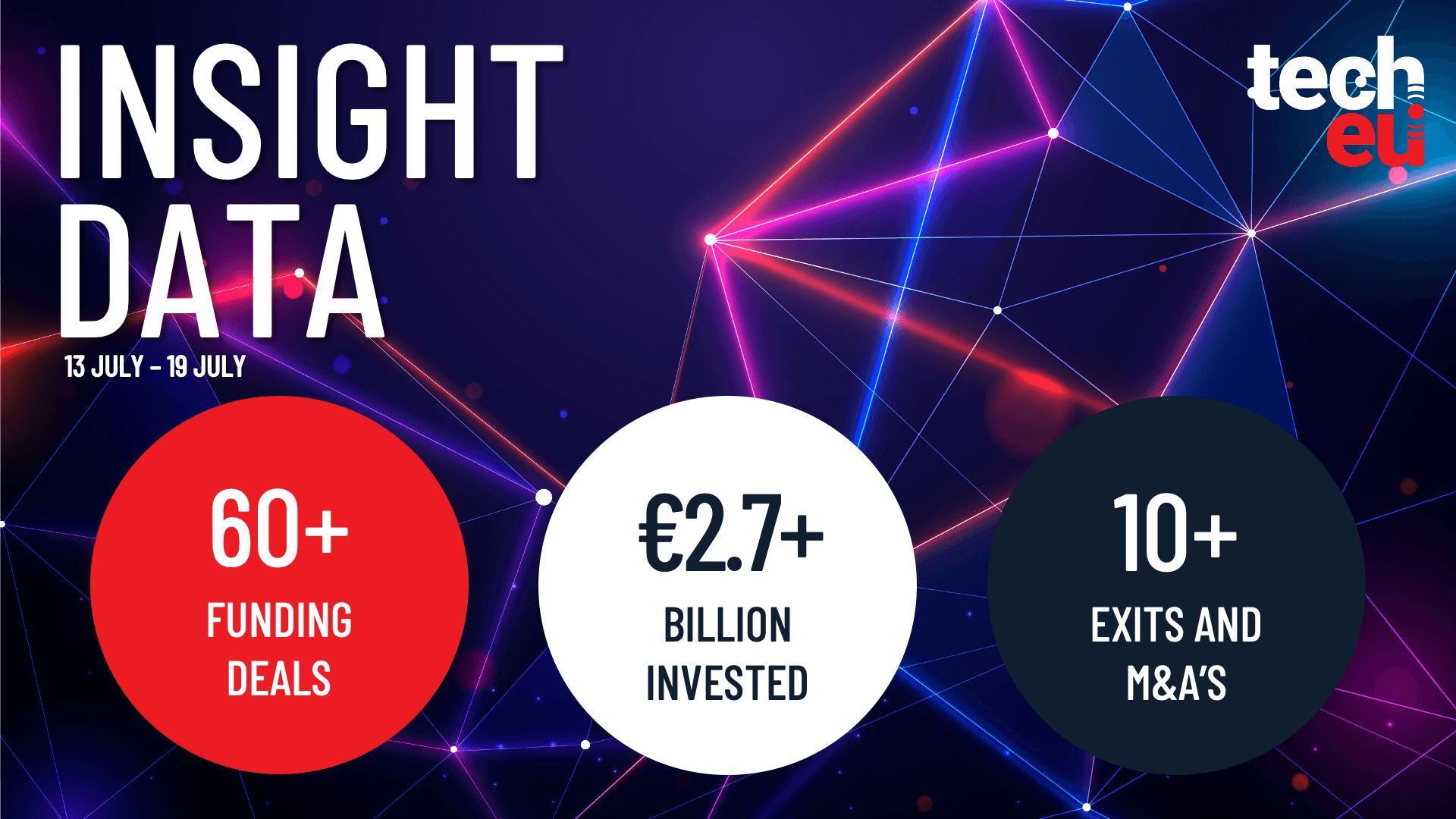
More than 60 tech funding deals worth over €2.7 billion were tracked in Europe last week, with artificial intelligence, healthtech, and software being the top industries. Germany, Sweden, and the UK led the countries with the most funding. The Tech.eu Funding Explorer provides deeper insights into funding data, investor activity, and market trends.

DeepSeek's new AI model uses a unified multimodal learner for clinical prediction, simplifying the process and achieving state-of-the-art results. This approach converts all patient data into a single natural language sequence and fine-tunes a pretrained language model. The model outperforms task-specific multimodal baselines and a clinically deployed gradient boosting system.
HuggingFace has introduced a new AI model, DanielTobi0/afrique-qwen-8b-health-finetuned-2, with 259 downloads and capabilities in text generation and health-focused applications. This model utilizes transformers, safetensors, and qwen3, showcasing advancements in AI technology. The model's performance and potential applications are of significant interest to the AI community.

This week, Helsing secured $1.8B Series E funding at an $18B valuation, while Uber acquired Delivery Hero in a €13B deal and Revolut announced plans to launch a US bank in 2027. These developments highlight significant investments and acquisitions in the European tech industry. The funding landscape is shifting, with notable trends in venture activity, investor moves, and emerging sectors.

Contrary to popular belief, the surge of billion-dollar 'seed' rounds in AI doesn't guarantee venture-like returns. Drawing parallels with biotech's history of capital-intensive startups, new data suggests that only a tiny fraction of mega-funded first rounds deliver exceptional investor outcomes, challenging the perceived rewrite of the venture model.
Meta has released a new AI model that combines reinforcement learning with large language models to create a more transparent and reliable insulin pump controller for Type 1 Diabetes patients. The model, called LLM-T1D, has shown promising results in blood sugar control and safety verification. This breakthrough has the potential to revolutionize the treatment of Type 1 Diabetes and improve the lives of millions of people worldwide.
Apple has released a new study on ontology-amplified distillation for sovereign enterprise language models, achieving impressive results in grounding tasks. The study combines two related FAOS studies, showcasing a proof-of-mechanism and a negative-results method. The findings have significant implications for regulated financial institutions and the development of tenant-owned language models.
A new study introduces a benchmark evaluation framework for measuring the faithfulness of LLM-generated clinical trial summaries, identifying Unsupported Claims as the dominant failure mode. The study evaluates three language models, including GPT-4o, Claude Sonnet 4.6, and Gemini 2.5 Flash, and proposes a knowledge-graph-augmented retrieval system to improve faithfulness scores. This research has significant implications for the use of LLMs in high-stakes contexts such as healthcare.
BatteryLake is a novel platform that standardizes and curates battery aging data, enabling advanced health management and benchmarking. This innovation has significant implications for the AI industry, developers, and businesses. By providing a governed data lakehouse, BatteryLake turns raw public battery data into benchmark-ready assets.
LongMedBench is a new benchmark for evaluating medical agents in long-horizon clinical decision-making. It provides a realistic assessment of AI models in medical care, emphasizing longitudinal interactions and multi-session decision-making. This benchmark has significant implications for the development of more accurate and reliable medical AI systems.
Google researchers introduce HCC-STAR, a clinical-reasoning LLM for risk stratification and treatment guidance in hepatocellular carcinoma. This model achieves state-of-the-art performance in treatment recommendation and risk stratification. The study demonstrates the potential of AI in precision therapy for HCC patients.
DeepSeek has unveiled a groundbreaking approach to abstract reasoning on ARC-AGI-1, leveraging an open-weight model (DeepSeek V3.2) in a 'non-thinking' mode, augmented by innovative agentic harnesses. This method achieves impressive generalization and pattern discovery, reaching up to 67.25% pass@2 with unprecedented cost-efficiency, sidestepping heavy compute or benchmark-specific fine-tuning.

Quantum Systems has raised $1.2 billion at an $8 billion valuation, while IQM becomes the first European quantum company to list on a major US exchange. This development is part of a larger trend of significant funding and investment in European startups, with over 55 tech funding deals worth over €1.6 billion in June. The European startup ecosystem is experiencing rapid growth, with notable acquisitions, mergers, and investments in various sectors.
Researchers from Anthropic have introduced a new diagnostic to evaluate the physics literacy of large language models (LLMs) in parallel physical worlds. The study tested three LLMs, including Claude Opus 4.7, GPT-5.5, and Gemini 3.1 Pro, and found significant gaps in their ability to reason about unfamiliar physics frameworks. The results have important implications for the development and application of LLMs in scientific and technical domains.
Anthropic has unveiled Claude Science, a flagship AI product engineered to transform scientific research, particularly in computational biology and drug development. Positioned alongside Claude Code, this standalone offering empowers researchers to autonomously carry out complex tasks, marking a significant strategic leap for Anthropic into the life sciences domain and intensifying competition in AI for scientific discovery.

OpenAI's outage led to account deactivations, causing users to lose their work and face delays in their projects.
Get the top AI stories in your inbox once a day, no spam.
Frequently Asked Questions
How often is AI Pulse updated?
New stories are added every couple of hours as they break, so the feed stays current throughout the day.
Where does ThinkSuite source its AI news from?
We pull from 100+ sources, including company blogs, research labs, and established tech publications, then fact check and summarize each story before it goes live.
Can I filter the news by company or topic?
Yes. Use the sidebar filters to narrow stories down by company (OpenAI, Anthropic, Google, and more), industry, or event type like funding and research.
Is AI Pulse free to use?
Yes. AI Pulse is free for anyone who wants to keep up with AI news, no sign up required. The daily newsletter is optional if you want updates in your inbox.