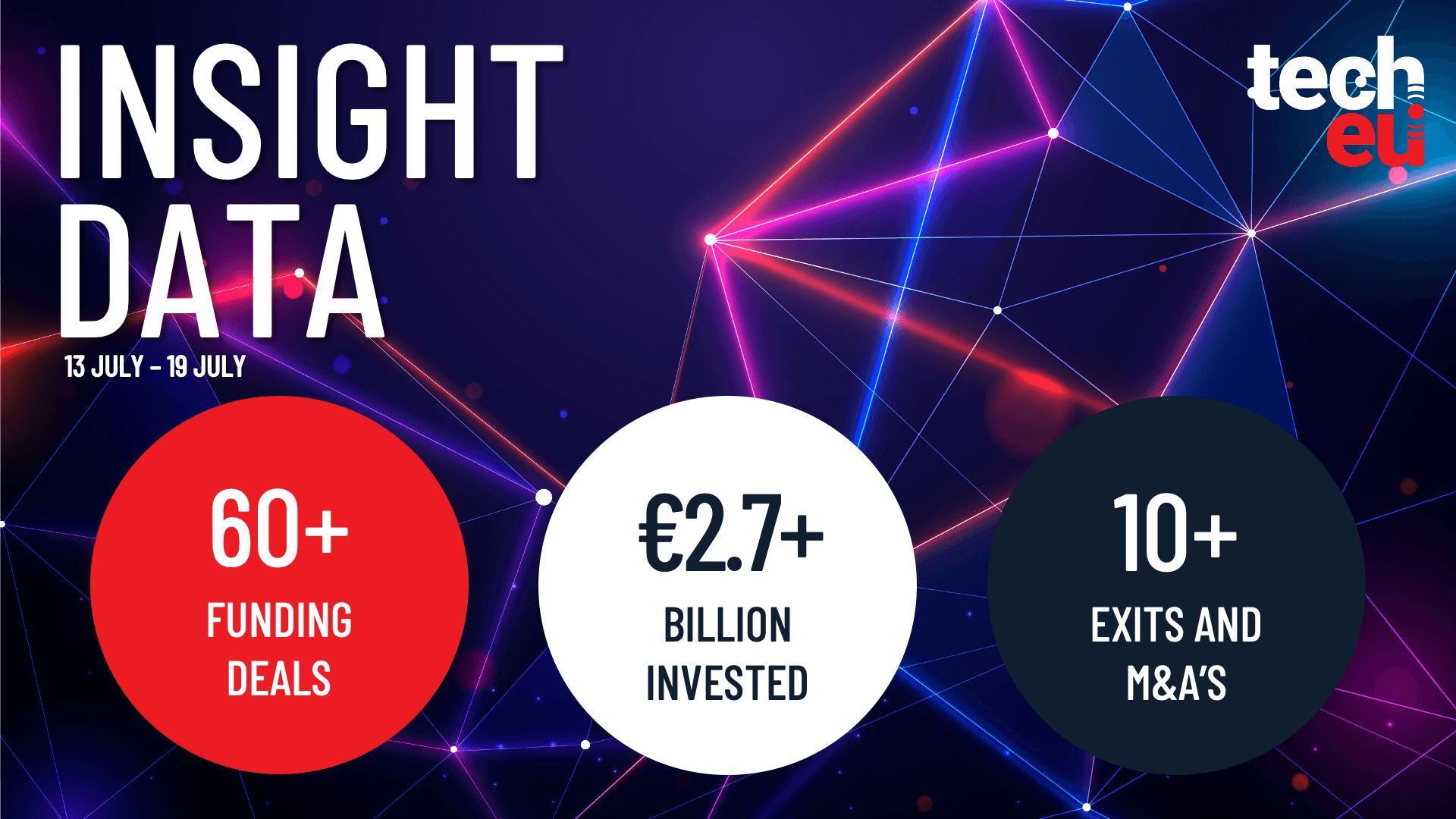
More than 60 tech funding deals worth over €2.7 billion were tracked in Europe last week, with artificial intelligence, healthtech, and software being the top industries. Germany, Sweden, and the UK led the countries with the most funding. The Tech.eu Funding Explorer provides deeper insights into funding data, investor activity, and market trends.

Moonshot's Kimi K3 has surpassed Fable 5 in frontend code, becoming the first Chinese model to top the Code Arena: Frontend rankings. However, it lags behind in complex math, scoring only 39% on FrontierMath Tier 4. This development has significant implications for the AI industry, with potential opportunities and risks for developers, businesses, and investors.

China's Moonshot AI has released Kimi K3, a model that matches Anthropic's Opus 4.8, raising questions about the importance of computing power in AI development. This release is reigniting the debate over US export controls and the future of AI. The implications of Kimi K3's release are far-reaching, with potential consequences for the AI industry and global technological landscape.

Anthropic is slashing Claude Fable 5 limits in Max and Team Premium plans, effective July 20, and pushing Pro users toward API pricing. This move comes as a surprise, given the company's initial plan to pull Fable from subscriptions entirely. The change is likely a response to competitive pressure from OpenAI's cheaper GPT-5.6 Sol.

Microsoft CEO Satya Nadella has publicly questioned Anthropic's 'Claude Fable' restrictions, stating they 'don't make sense.' This critique highlights a growing tension in the AI industry regarding model accessibility, control, and the divergent strategies of leading AI developers for enterprise adoption and innovation.

This week, Helsing secured $1.8B Series E funding at an $18B valuation, while Uber acquired Delivery Hero in a €13B deal and Revolut announced plans to launch a US bank in 2027. These developments highlight significant investments and acquisitions in the European tech industry. The funding landscape is shifting, with notable trends in venture activity, investor moves, and emerging sectors.

Kimi has unveiled K3, a powerful multimodal open-weight model with 2.8 trillion parameters and a 1-million-token context window, challenging top proprietary models like GPT-5.6 Sol and Claude Fable 5. This launch, however, comes with a significantly higher price tag, signaling a strategic shift for Chinese AI providers away from super-cheap offerings.
Alexandre LeBrun, CEO of AMI Labs, a world model startup co-founded by Yann LeCun, is taking a firm stance against using the terms 'AGI' and 'superintelligence' to describe his company's advanced AI. This move challenges the prevailing industry narrative and signals a deliberate shift towards more grounded terminology in AI development.
Anthropic, the world's most valuable AI company, has made a groundbreaking discovery in mechanistic interpretability, shedding light on the inner workings of its AI models. This breakthrough has significant implications for the AI industry, developers, and businesses. The company's research has the potential to revolutionize the way we understand and interact with AI systems.
Microsoft CEO Satya Nadella has issued a stark warning to companies leveraging AI, likening proprietary models from giant AI labs to 'Trojan horses.' This significant statement underscores growing concerns about vendor lock-in, data privacy, and the strategic implications of over-reliance on opaque AI systems.
BatteryLake is a novel platform that standardizes and curates battery aging data, enabling advanced health management and benchmarking. This innovation has significant implications for the AI industry, developers, and businesses. By providing a governed data lakehouse, BatteryLake turns raw public battery data into benchmark-ready assets.
OpenAI introduces a new method for detecting model distillation in large language models, raising questions about fairness and policy violations. The approach uses reference-based membership inference to identify teacher models. This breakthrough has significant implications for the AI industry, developers, and businesses.
Elon Musk and Sam Altman are sparring on X after Apple filed a lawsuit against OpenAI, accusing the company of stealing trade secrets. The lawsuit has sparked a heated debate between Musk and Altman, with both sides trading insults. The outcome of the lawsuit could have significant implications for the AI industry.
LongMedBench is a new benchmark for evaluating medical agents in long-horizon clinical decision-making. It provides a realistic assessment of AI models in medical care, emphasizing longitudinal interactions and multi-session decision-making. This benchmark has significant implications for the development of more accurate and reliable medical AI systems.
Groundbreaking Arxiv research reveals how large language model safety mechanisms are encoded and can be bypassed, introducing novel 'Activation-Guided' adversarial attacks. The study finds safety representations are distributed across model layers, not localized, and proposes a 33x faster attack method, Soft-GCG, offering critical insights for designing more robust AI alignment strategies.
DeepSeek's new Director system accelerates distributed MoE serving via online proactive expert placement, reducing end-to-end latency by 11-55%. This breakthrough has significant implications for the AI industry, enabling faster and more efficient model serving. The Director system uses prediction-driven expert placement and online migration to minimize downtime and optimize performance.

The Free Software Foundation has been fighting web crawlers and botnets for nearly two years, using a tool called reaction to block millions of IPs. The foundation's systems administrator has shared their experience and techniques for identifying and blocking botnet traffic. This approach has significant implications for the AI industry and cybersecurity.

Europe's tech ecosystem is witnessing a significant resurgence, with over €2.8 billion in funding deals reported this week, signaling a robust venture capital rebound. Major investments into hyperscalers like Nscale, deep tech pioneers such as Proxima Fusion, and strategic AI acquisitions underscore a growing confidence in the continent's innovation capacity and its pivotal role in the future of AI.
OpenAI CEO suggests that video games can be a superior training data source than the internet for achieving AGI, with significant implications for the AI industry.
MIT Technology Review highlights critical AI architecture elements for IT leaders navigating rapid AI evolution and the rise of agentic systems. The article emphasizes data preparation as a core foundational component, guiding organizations on building stable, integrated AI systems to support future capabilities and mitigate investment risks.
Get the top AI stories in your inbox once a day, no spam.
Frequently Asked Questions
How often is AI Pulse updated?
New stories are added every couple of hours as they break, so the feed stays current throughout the day.
Where does ThinkSuite source its AI news from?
We pull from 100+ sources, including company blogs, research labs, and established tech publications, then fact check and summarize each story before it goes live.
Can I filter the news by company or topic?
Yes. Use the sidebar filters to narrow stories down by company (OpenAI, Anthropic, Google, and more), industry, or event type like funding and research.
Is AI Pulse free to use?
Yes. AI Pulse is free for anyone who wants to keep up with AI news, no sign up required. The daily newsletter is optional if you want updates in your inbox.