
Alibaba's Qwen team has launched Qwen-Image-3.0, a groundbreaking AI image generator capable of rendering full infographic grids and legible text down to ten pixels in a single pass. This new model boasts an impressive 4,500-token prompt capacity and native support for twelve languages, setting a new benchmark for complexity and textual accuracy in AI-generated visuals.

OpenAI introduces RobustMAD, a benchmark for evaluating multimodal small language models' real-world robustness in anomaly detection. The study reveals promising capabilities of compact models but also critical robustness gaps. RobustMAD provides actionable guidance for designing next-generation industrial inspection assistants.
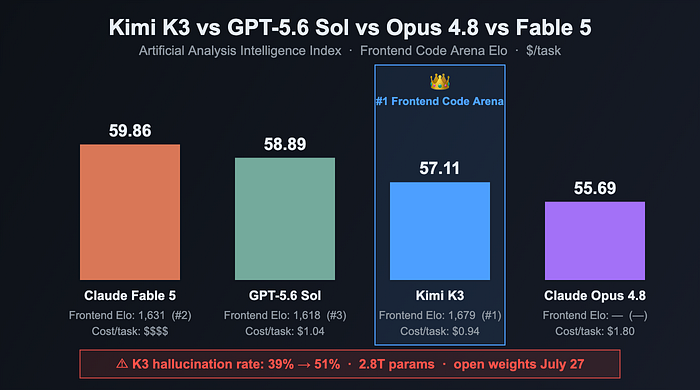
Moonshot AI's Kimi K3, a 2.8-trillion-parameter open-weight model, has surged to the #1 spot on Arena.ai's Frontend Code Arena, outperforming leading models like Claude Fable 5 and GPT-5.6 Sol. This impressive coding prowess is, however, tempered by a significant 51% hallucination rate, raising critical questions about its reliability for advanced agentic pipelines despite its benchmark victories.
A groundbreaking arXiv paper systematically evaluates leading Large Language Models—including GPT-4 Turbo, Claude 3 Opus, and FinGPT—for their efficacy in technical market analysis and algorithmic trading. The research reveals promising results, with top models outperforming benchmarks, yet also highlights critical limitations like numerical hallucination and context window issues that demand further refinement for robust deployment.
A new study introduces a benchmark evaluation framework for measuring the faithfulness of LLM-generated clinical trial summaries, identifying Unsupported Claims as the dominant failure mode. The study evaluates three language models, including GPT-4o, Claude Sonnet 4.6, and Gemini 2.5 Flash, and proposes a knowledge-graph-augmented retrieval system to improve faithfulness scores. This research has significant implications for the use of LLMs in high-stakes contexts such as healthcare.
BatteryLake is a novel platform that standardizes and curates battery aging data, enabling advanced health management and benchmarking. This innovation has significant implications for the AI industry, developers, and businesses. By providing a governed data lakehouse, BatteryLake turns raw public battery data into benchmark-ready assets.
LongMedBench is a new benchmark for evaluating medical agents in long-horizon clinical decision-making. It provides a realistic assessment of AI models in medical care, emphasizing longitudinal interactions and multi-session decision-making. This benchmark has significant implications for the development of more accurate and reliable medical AI systems.
DeepSeek has unveiled a groundbreaking approach to abstract reasoning on ARC-AGI-1, leveraging an open-weight model (DeepSeek V3.2) in a 'non-thinking' mode, augmented by innovative agentic harnesses. This method achieves impressive generalization and pattern discovery, reaching up to 67.25% pass@2 with unprecedented cost-efficiency, sidestepping heavy compute or benchmark-specific fine-tuning.
Woodside Energy is revolutionizing the energy sector by integrating advanced AI, including agentic systems and AI copilots, into its core industrial operations. Moving beyond consumer-facing applications, this initiative focuses on augmenting human expertise in high-stakes environments like LNG plant startups, setting a new benchmark for enterprise AI adoption.
Microsoft Research introduces Memora, a harmonic memory representation that balances abstraction and specificity, enabling AI agents to recall past interactions and scale capabilities. This innovation outperforms existing models, using up to 98% fewer context tokens. Memora sets new state-of-the-art on LoCoMo and LongMemEval benchmarks.
A new arXiv study shows OpenEvidence's specialized clinical tool beats top general‑purpose models (Claude Opus 4.8, Gemini 3.1 Pro, GPT‑5.5) on 620 real‑world point‑of‑care questions. Physicians across 30 specialties rated the specialized tool higher on accuracy, utility, source quality, verifiability and completeness.

OpenAI introduces IMCBench, a benchmark for multimodal large language models in image-grounded medical conversations, evaluating safety, accuracy, and uncertainty in diagnosis. The benchmark tests eight models, with Claude Opus 4.6 achieving the highest overall score. The results highlight the need for multi-dimensional evaluation frameworks in medical AI.
Get the top AI stories in your inbox once a day, no spam.
Frequently Asked Questions
How often is AI Pulse updated?
New stories are added every couple of hours as they break, so the feed stays current throughout the day.
Where does ThinkSuite source its AI news from?
We pull from 100+ sources, including company blogs, research labs, and established tech publications, then fact check and summarize each story before it goes live.
Can I filter the news by company or topic?
Yes. Use the sidebar filters to narrow stories down by company (OpenAI, Anthropic, Google, and more), industry, or event type like funding and research.
Is AI Pulse free to use?
Yes. AI Pulse is free for anyone who wants to keep up with AI news, no sign up required. The daily newsletter is optional if you want updates in your inbox.