
Researchers introduce PlanFlip, a framework to attack multi-agent LLM systems via planning-phase prompt injection, revealing vulnerabilities in popular models like GPT-5 and Llama-3.3-70B. The study highlights the importance of heterogeneous model diversity for security. PlanFlip's four attacks can corrupt downstream sub-tasks, evading keyword filters and compromising system integrity.
OpenAI's latest study explores the necessity of executable world models, simplification, and verification in coding agents, revealing surprising results. The research evaluates four nested Codex-based agents, finding that every agent variant improves with stronger models and greater reasoning effort. The study's findings have significant implications for the development of Artificial General Intelligence (AGI).
OpenAI CEO suggests that video games can be a superior training data source than the internet for achieving AGI, with significant implications for the AI industry.
A new arXiv paper by Alibaba researchers details a ReAct-style agentic setup integrating Large Language Models with SageMath, a powerful Computer Algebra System. This novel approach demonstrates substantial performance gains across frontier LLMs in solving research-level mathematical problems, significantly narrowing the capability gap between open-weight and closed models and paving the way for automated conjecture discovery.
HuggingFace has released a new AI model, EnzGamers/ABCDAI-R1-1.5b-SFT, with 4,126 downloads and 2 likes. This model is part of the transformers family and utilizes safetensors and qwen2 for text generation. The model has been generated from a trainer and features SFT technology.
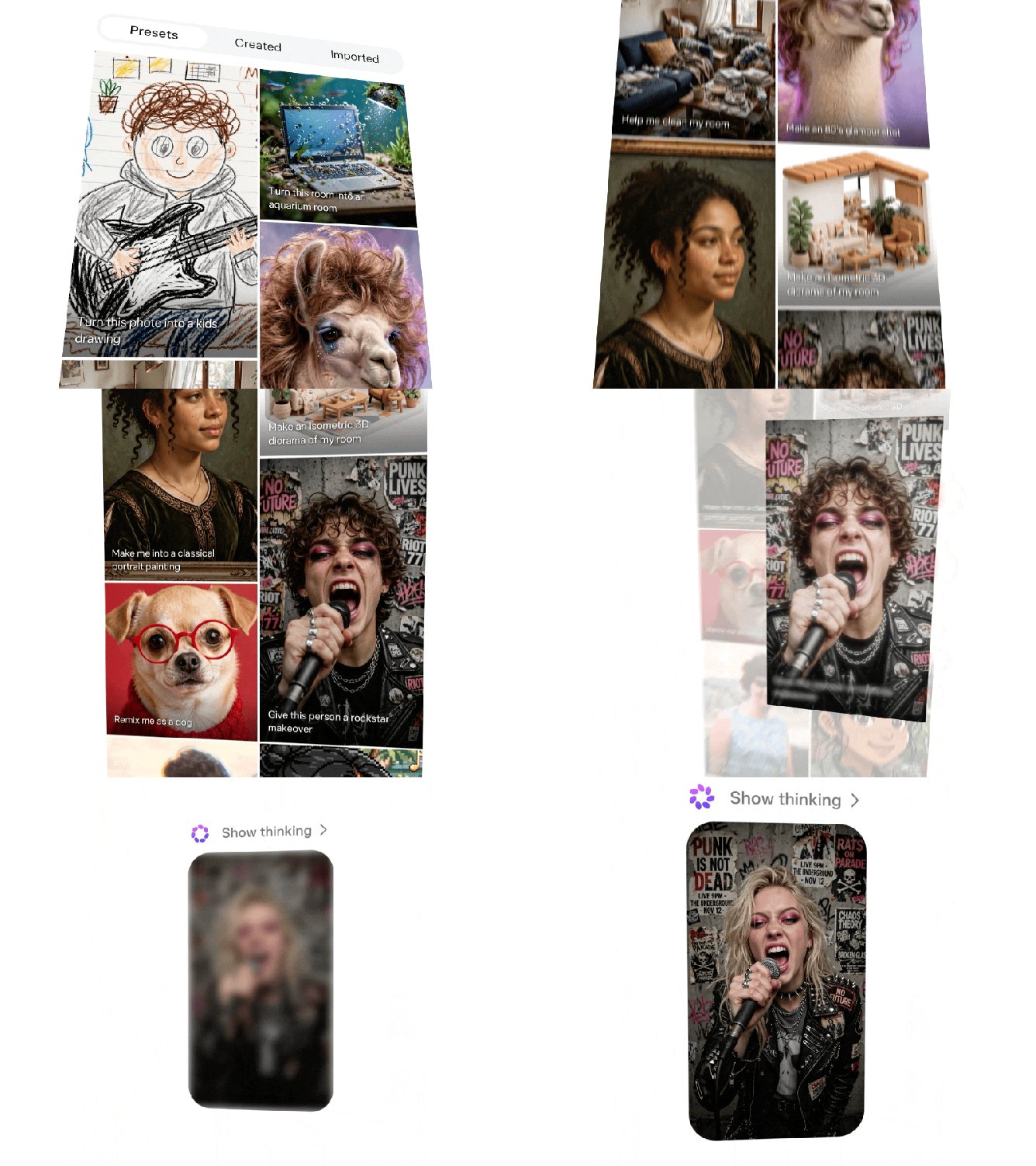
Meta has officially rolled out Muse Image, its inaugural image generation model from Meta Superintelligence Labs, directly embedding advanced AI creativity into Meta AI and its suite of popular apps. This new capability transforms conversational prompts into high-quality visuals, making personalized content creation easier than ever for billions of users worldwide.
Get the top AI stories in your inbox once a day, no spam.
Frequently Asked Questions
How often is AI Pulse updated?
New stories are added every couple of hours as they break, so the feed stays current throughout the day.
Where does ThinkSuite source its AI news from?
We pull from 100+ sources, including company blogs, research labs, and established tech publications, then fact check and summarize each story before it goes live.
Can I filter the news by company or topic?
Yes. Use the sidebar filters to narrow stories down by company (OpenAI, Anthropic, Google, and more), industry, or event type like funding and research.
Is AI Pulse free to use?
Yes. AI Pulse is free for anyone who wants to keep up with AI news, no sign up required. The daily newsletter is optional if you want updates in your inbox.