
Alibaba's Qwen team has launched Qwen-Image-3.0, a groundbreaking AI image generator capable of rendering full infographic grids and legible text down to ten pixels in a single pass. This new model boasts an impressive 4,500-token prompt capacity and native support for twelve languages, setting a new benchmark for complexity and textual accuracy in AI-generated visuals.

OpenAI introduces RobustMAD, a benchmark for evaluating multimodal small language models' real-world robustness in anomaly detection. The study reveals promising capabilities of compact models but also critical robustness gaps. RobustMAD provides actionable guidance for designing next-generation industrial inspection assistants.
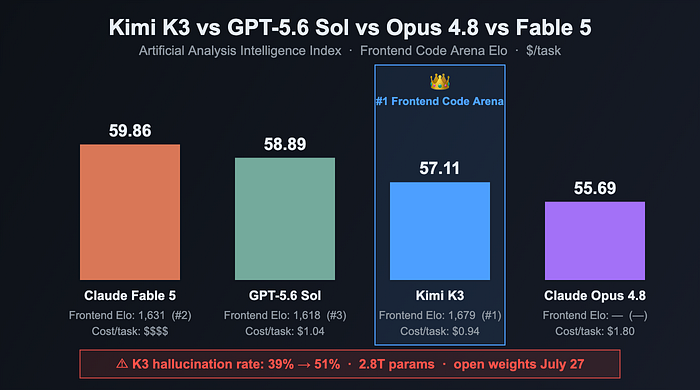
Moonshot AI's Kimi K3, a 2.8-trillion-parameter open-weight model, has surged to the #1 spot on Arena.ai's Frontend Code Arena, outperforming leading models like Claude Fable 5 and GPT-5.6 Sol. This impressive coding prowess is, however, tempered by a significant 51% hallucination rate, raising critical questions about its reliability for advanced agentic pipelines despite its benchmark victories.
MarkTechPost compared Qwen, Gemma, Mistral, and DeepSeek, the best local LLMs that can run on a single 24GB GPU in 2026. This comparison highlights the performance and capabilities of each model, providing insights for developers and businesses. The article discusses the key details, technical analysis, and industry impact of these LLMs.
Discover the top local LLMs that can run on a single 24GB GPU in 2026, including Qwen, Gemma, Mistral, and DeepSeek. Learn how to choose the right model for your needs and optimize performance. Get the latest insights on AI model development and deployment.

Alibaba's Qwen team has released Qwen 3.8, a multimodal AI model with 2.4 trillion parameters, rivaling leading models and trailing only Fable 5. The model is available for preview now. This development is set to significantly impact the AI landscape, offering enhanced capabilities and potential applications across various industries.

Moonshot's Kimi K3 has surpassed Fable 5 in frontend code, becoming the first Chinese model to top the Code Arena: Frontend rankings. However, it lags behind in complex math, scoring only 39% on FrontierMath Tier 4. This development has significant implications for the AI industry, with potential opportunities and risks for developers, businesses, and investors.
The AI landscape is rapidly evolving as three Chinese labs—Moonshot AI, DeepSeek, and Zhipu AI—release powerful, open-weight Mixture-of-Experts (MoE) models. Kimi K3, DeepSeek V4 Pro, and GLM-5.2 are pushing the boundaries of scale and capability, offering trillion-scale parameters and million-token context windows for complex coding and agent workloads, fundamentally shifting the open-source AI leaderboard.

China's Moonshot AI has released Kimi K3, a model that matches Anthropic's Opus 4.8, raising questions about the importance of computing power in AI development. This release is reigniting the debate over US export controls and the future of AI. The implications of Kimi K3's release are far-reaching, with potential consequences for the AI industry and global technological landscape.
Microsoft CEO Satya Nadella has publicly questioned Anthropic's 'Claude Fable' restrictions, stating they 'don't make sense.' This critique highlights a growing tension in the AI industry regarding model accessibility, control, and the divergent strategies of leading AI developers for enterprise adoption and innovation.

Xi Jinping promoted a vision of low-cost, broadly accessible AI and called for international cooperation at China's World AI Conference. Chinese models are gaining traction worldwide, with a record 60% share of US firms' AI usage on OpenRouter. Beijing is balancing openness with national security as models grow more capable.

Kimi has unveiled K3, a powerful multimodal open-weight model with 2.8 trillion parameters and a 1-million-token context window, challenging top proprietary models like GPT-5.6 Sol and Claude Fable 5. This launch, however, comes with a significantly higher price tag, signaling a strategic shift for Chinese AI providers away from super-cheap offerings.
Alexandre LeBrun, CEO of AMI Labs, a world model startup co-founded by Yann LeCun, is taking a firm stance against using the terms 'AGI' and 'superintelligence' to describe his company's advanced AI. This move challenges the prevailing industry narrative and signals a deliberate shift towards more grounded terminology in AI development.
Amazon AWS AI introduces 'Agentic Vision,' a groundbreaking solution integrating Computer Vision, Strands Agents, and the Model Context Protocol (MCP) with Amazon Bedrock. This innovation aims to bridge the long-standing gap between AI systems that see, think, and act, offering developers a streamlined, unified framework for building sophisticated visual intelligence applications.
Microsoft CEO Satya Nadella has issued a stark warning to companies leveraging AI, likening proprietary models from giant AI labs to 'Trojan horses.' This significant statement underscores growing concerns about vendor lock-in, data privacy, and the strategic implications of over-reliance on opaque AI systems.
Anthropic has unveiled groundbreaking research detailing its ability to 'read' the internal states, or 'thoughts,' of its Claude AI models. This pivotal study reveals the existence of a 'global workspace' within LLMs, offering unprecedented insights into their complex decision-making processes and significantly advancing the field of AI interpretability.
OpenAI introduces GPT-5.6, a groundbreaking AI model that sets new standards for intelligence and efficiency. This model achieves state-of-the-art results in various fields, outperforming previous models at lower costs. GPT-5.6 is available in three variants: Sol, Terra, and Luna, catering to different needs and budgets.
A groundbreaking Arxiv paper introduces LLMForge, a multi-model text-to-CAD framework that enables automatic generation of parametric 3D mechanical designs from natural language. This framework, featuring innovative iterative refinement and VLM-based critique, demonstrates remarkable success, with top models like DeepSeek-V3.2 achieving near-perfect mesh generation and showing compact models can rival larger systems.
Get the top AI stories in your inbox once a day, no spam.
Frequently Asked Questions
How often is AI Pulse updated?
New stories are added every couple of hours as they break, so the feed stays current throughout the day.
Where does ThinkSuite source its AI news from?
We pull from 100+ sources, including company blogs, research labs, and established tech publications, then fact check and summarize each story before it goes live.
Can I filter the news by company or topic?
Yes. Use the sidebar filters to narrow stories down by company (OpenAI, Anthropic, Google, and more), industry, or event type like funding and research.
Is AI Pulse free to use?
Yes. AI Pulse is free for anyone who wants to keep up with AI news, no sign up required. The daily newsletter is optional if you want updates in your inbox.