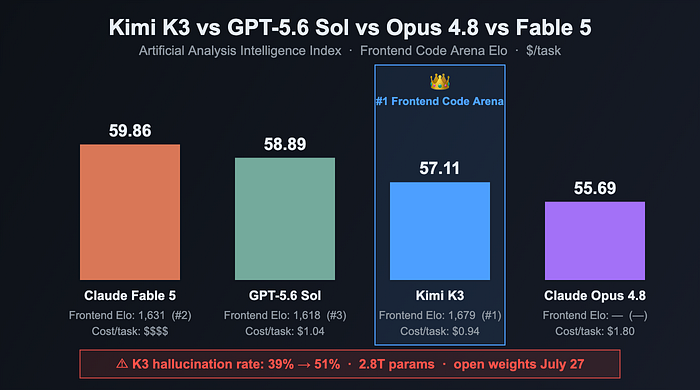
Moonshot AI's Kimi K3, a 2.8-trillion-parameter open-weight model, has surged to the #1 spot on Arena.ai's Frontend Code Arena, outperforming leading models like Claude Fable 5 and GPT-5.6 Sol. This impressive coding prowess is, however, tempered by a significant 51% hallucination rate, raising critical questions about its reliability for advanced agentic pipelines despite its benchmark victories.

Smartsheet has developed a pioneering remote Model Context Protocol (MCP) server on AWS, enabling AI clients like Claude Desktop and Amazon Quick to securely access and interact with enterprise data. This innovative solution optimizes AI interactions, significantly reduces token costs, and enhances the reliability of AI agents operating within Smartsheet's platform. It marks a significant step towards seamless AI integration in enterprise work management.
Google has released a new model called Graph-Regularized Agentic Context Evolution (GRACE) to improve the reliability of long-horizon agentic context evolution under distribution shift. This model maintains the persistent instruction component as a typed semantic graph and validates proposed updates within the local typed neighborhoods of modified nodes. The results show a significant improvement in strict reliability compared to the baseline models.

Amazon introduces Bedrock AgentCore Observability to debug production AI agents, providing visibility into agent execution and decision-making. This feature addresses the challenges of silent failures in AI agents, enabling developers to identify and resolve issues efficiently. With this release, Amazon aims to improve the reliability and performance of AI systems.

Google and other companies are developing classical computing infrastructure to support the growth of quantum computers, which require dedicated classical hardware to operate. Quantum computers promise to solve complex problems, but their reliability depends on classical computing. Companies like Nvidia, IBM Quantum, and Google Quantum AI are working on classical hardware and software to support quantum computing.
Get the top AI stories in your inbox once a day, no spam.
Frequently Asked Questions
How often is AI Pulse updated?
New stories are added every couple of hours as they break, so the feed stays current throughout the day.
Where does ThinkSuite source its AI news from?
We pull from 100+ sources, including company blogs, research labs, and established tech publications, then fact check and summarize each story before it goes live.
Can I filter the news by company or topic?
Yes. Use the sidebar filters to narrow stories down by company (OpenAI, Anthropic, Google, and more), industry, or event type like funding and research.
Is AI Pulse free to use?
Yes. AI Pulse is free for anyone who wants to keep up with AI news, no sign up required. The daily newsletter is optional if you want updates in your inbox.