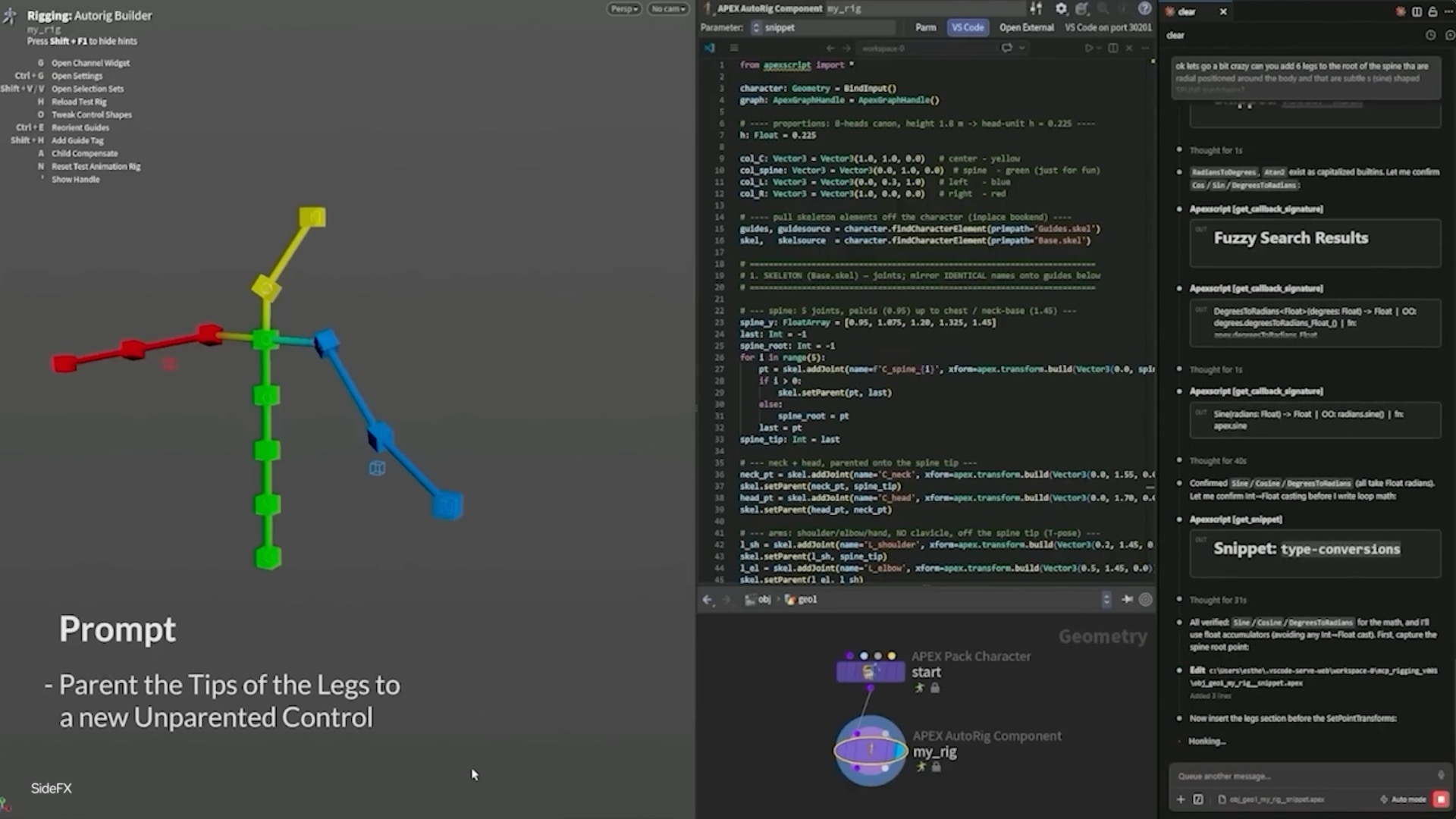
NVIDIA made significant strides at SIGGRAPH 2026, showcasing how agentic and physical AI are set to revolutionize graphics, simulation, and digital world creation. Key announcements included new tools for AI-driven content creation, advanced neural rendering techniques, and an open world model for local physical AI, redefining realism and automation across industries.

OpenAI's GPT-5.6 Sol Ultra has solved the 50-year-old Cycle Double Cover Conjecture, a fundamental problem in graph theory. The proof was generated in under an hour using 64 subagents working in parallel.

OpenAI CEO suggests that video games can be a superior training data source than the internet for achieving AGI, with significant implications for the AI industry.
Discover the leading multimodal Large Language Models (LLMs) transforming AI, including GPT-5.5 and Gemini 3 Pro, and their applications in enterprise innovation, research, and software development. These models offer powerful capabilities for text, images, audio, video, and code understanding, revolutionizing virtual assistants, automation, and creative digital experiences. With their advanced reasoning abilities and integration with various tools, multimodal LLMs are poised to reshape businesses and industries worldwide.
Anthropic has released version 0.115.0 of its SDK for Python, introducing new features such as support for Managed Agents event delta streaming and agent overrides. This update aims to enhance the functionality and usability of the Anthropics SDK, providing developers with more tools to work with AI models. The release is part of Anthropic's ongoing efforts to improve its offerings and stay competitive in the AI market.
NVIDIA's full-stack inference software, optimized for the Blackwell platform, slashes token costs by 5x on DeepSeek V4. Companies like Baseten and Cognition leverage NVIDIA's tools to scale AI workloads efficiently, marking a shift from hardware specs to cost-per-token economics.
A groundbreaking MIT study reveals how labeling AI agents as 'employees' leads to worse human oversight, as companies like OpenAI push agentic AI tools. New research shows a 18% drop in error detection when AI work is framed as coming from 'digital coworkers.'

OpenAI introduces ATHENA-R1, an AI agent for treatment reasoning that outperforms language models and tool-use systems. Trained on 212 biomedical tools, ATHENA-R1 achieves 94.7% accuracy on open-ended drug reasoning and 82.9% on treatment reasoning. This breakthrough has significant implications for the healthcare industry and AI research.
Get the top AI stories in your inbox once a day, no spam.
Frequently Asked Questions
How often is AI Pulse updated?
New stories are added every couple of hours as they break, so the feed stays current throughout the day.
Where does ThinkSuite source its AI news from?
We pull from 100+ sources, including company blogs, research labs, and established tech publications, then fact check and summarize each story before it goes live.
Can I filter the news by company or topic?
Yes. Use the sidebar filters to narrow stories down by company (OpenAI, Anthropic, Google, and more), industry, or event type like funding and research.
Is AI Pulse free to use?
Yes. AI Pulse is free for anyone who wants to keep up with AI news, no sign up required. The daily newsletter is optional if you want updates in your inbox.