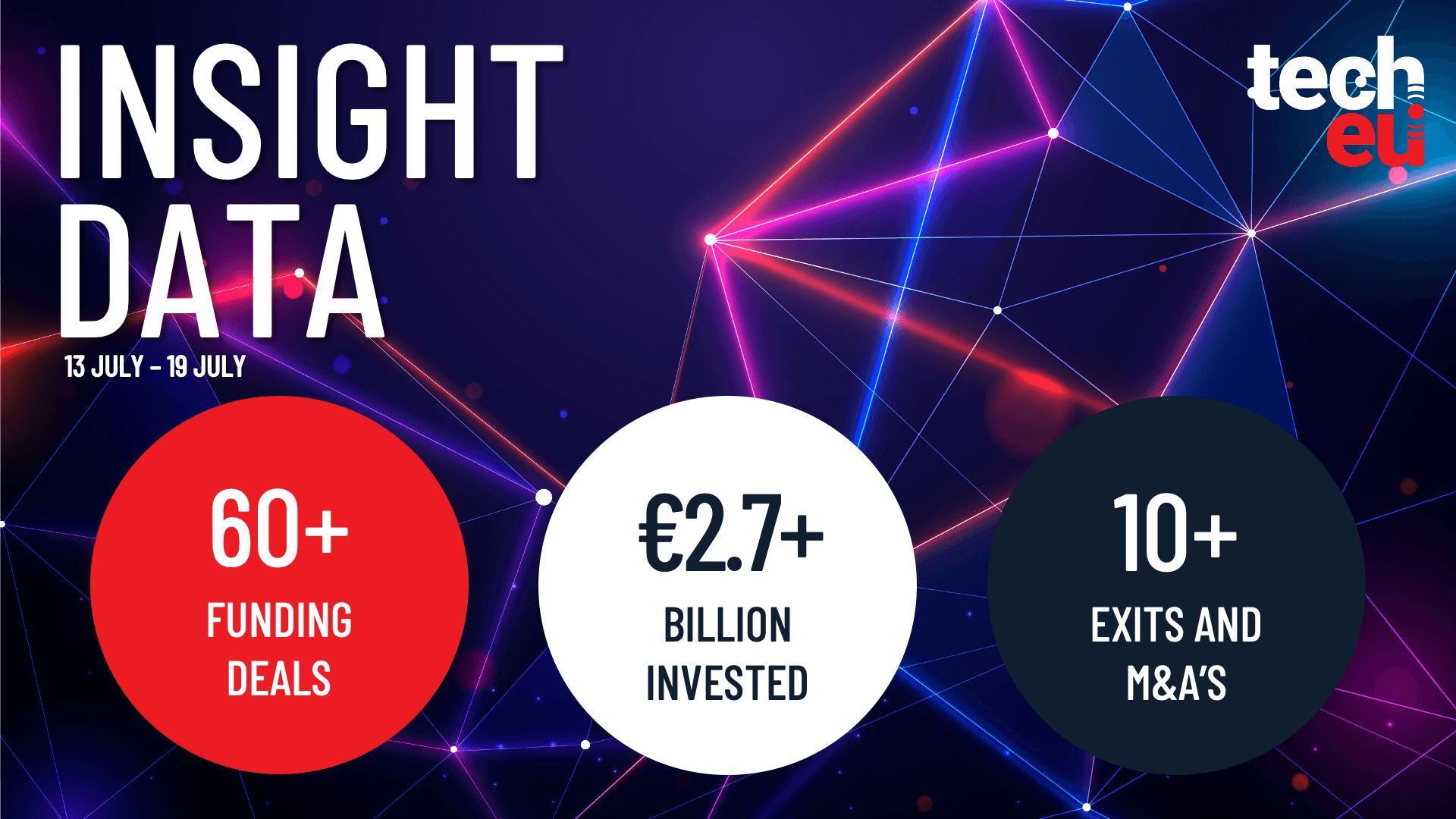
More than 60 tech funding deals worth over €2.7 billion were tracked in Europe last week, with artificial intelligence, healthtech, and software being the top industries. Germany, Sweden, and the UK led the countries with the most funding. The Tech.eu Funding Explorer provides deeper insights into funding data, investor activity, and market trends.

NVIDIA CEO Jensen Huang's recent visit to Japan has sparked significant interest in the tech community, with deals spanning the entire Japanese tech ecosystem. This move is expected to have far-reaching implications for the AI industry, with potential collaborations and acquisitions on the horizon. As the AI landscape continues to evolve, Huang's visit marks a pivotal moment in NVIDIA's expansion into the Japanese market.

A new demo showcases an AI event venue operator built with MongoDB Atlas, Voyage, and LangGraph, enabling agents to remember prior events and respond to live operational changes. This technology has significant implications for the event management industry, particularly for high-stakes events like tennis tournaments. The demo highlights the potential for AI to improve event operations and enhance the fan experience.

The British Business Bank has committed €25 million to EQT Life Sciences' EQT Health Economics 3 Fund, supporting high-potential life sciences companies in the UK. This investment is part of the Bank's ongoing efforts to back the UK's life sciences sector, one of the eight growth sectors of the UK Industrial Strategy. The fund will focus on commercial-stage, de-risked medtech and digital health technologies.

This week, Helsing secured $1.8B Series E funding at an $18B valuation, while Uber acquired Delivery Hero in a €13B deal and Revolut announced plans to launch a US bank in 2027. These developments highlight significant investments and acquisitions in the European tech industry. The funding landscape is shifting, with notable trends in venture activity, investor moves, and emerging sectors.

Alexandre LeBrun, CEO of AMI Labs, a world model startup co-founded by Yann LeCun, is taking a firm stance against using the terms 'AGI' and 'superintelligence' to describe his company's advanced AI. This move challenges the prevailing industry narrative and signals a deliberate shift towards more grounded terminology in AI development.

Sam Altman's public dismissal of 'space data centers' as a viable public market investment, aimed at Elon Musk, has ignited a crucial debate about the future of AI compute infrastructure. This 'trash talk,' validated by many experts, underscores the immense challenges and economic realities facing ambitious off-world computing visions. The exchange highlights a divergence in strategic thinking between two AI titans regarding where the industry's significant capital should be directed.
Microsoft CEO Satya Nadella has issued a stark warning to companies leveraging AI, likening proprietary models from giant AI labs to 'Trojan horses.' This significant statement underscores growing concerns about vendor lock-in, data privacy, and the strategic implications of over-reliance on opaque AI systems.
BatteryLake is a novel platform that standardizes and curates battery aging data, enabling advanced health management and benchmarking. This innovation has significant implications for the AI industry, developers, and businesses. By providing a governed data lakehouse, BatteryLake turns raw public battery data into benchmark-ready assets.

The public feud between Elon Musk and Sam Altman has reignited, highlighting a fundamental ideological battle over AI's future, safety, and commercialization. This ongoing conflict, centered around OpenAI's mission and direction, is sending ripples across the entire AI ecosystem. As two of the most influential figures in tech clash, their disagreements could profoundly shape how artificial intelligence is developed and governed.
LongMedBench is a new benchmark for evaluating medical agents in long-horizon clinical decision-making. It provides a realistic assessment of AI models in medical care, emphasizing longitudinal interactions and multi-session decision-making. This benchmark has significant implications for the development of more accurate and reliable medical AI systems.
Groundbreaking Arxiv research reveals how large language model safety mechanisms are encoded and can be bypassed, introducing novel 'Activation-Guided' adversarial attacks. The study finds safety representations are distributed across model layers, not localized, and proposes a 33x faster attack method, Soft-GCG, offering critical insights for designing more robust AI alignment strategies.
This week in tech saw the AI industry's titans clash, as Elon Musk's legal battle with Sam Altman and OpenAI escalated, questioning the very ethos of AI development. Simultaneously, industry leaders like Howard Lutnick weighed in, highlighting the profound implications for innovation, regulation, and market dynamics.

The Free Software Foundation has been fighting web crawlers and botnets for nearly two years, using a tool called reaction to block millions of IPs. The foundation's systems administrator has shared their experience and techniques for identifying and blocking botnet traffic. This approach has significant implications for the AI industry and cybersecurity.

Europe's tech ecosystem is witnessing a significant resurgence, with over €2.8 billion in funding deals reported this week, signaling a robust venture capital rebound. Major investments into hyperscalers like Nscale, deep tech pioneers such as Proxima Fusion, and strategic AI acquisitions underscore a growing confidence in the continent's innovation capacity and its pivotal role in the future of AI.
A European fertility group is advocating for international limits on sperm donations, citing the ethical dilemma of donor-conceived individuals discovering hundreds of siblings and the erosion of anonymity through consumer genetic testing services. This move underscores a growing challenge at the intersection of advanced reproductive technologies, vast genetic datasets, and evolving societal norms, demanding urgent policy and technological solutions.
MIT Technology Review highlights critical AI architecture elements for IT leaders navigating rapid AI evolution and the rise of agentic systems. The article emphasizes data preparation as a core foundational component, guiding organizations on building stable, integrated AI systems to support future capabilities and mitigate investment risks.
California's ambitious climate program, paying farmers to convert methane from manure into natural gas, is under fire. A recent MIT Technology Review exposé reveals that these lucrative carbon offset schemes may dramatically overstate actual emissions reductions, highlighting critical flaws in policy design and measurement. This situation underscores the urgent need for advanced AI and data analytics to ensure transparency and efficacy in climate action.
New research from arXiv challenges conventional wisdom on AI improvement from feedback, revealing that multi-turn gains often mask true learning. The study highlights that an AI model's ability to effectively *utilize* feedback, rather than merely receiving it, is the critical bottleneck for interactive improvement, especially when compared to unguided self-refinement or simple retries.
Podcasting platform Riverside has expanded into newsletter publishing with an AI-driven feature that transforms audio content into written newsletters. This move aims to streamline content repurposing for creators, leveraging AI to summarize podcasts, generate summaries, and publish cross-platform newsletters.
Get the top AI stories in your inbox once a day, no spam.
Frequently Asked Questions
How often is AI Pulse updated?
New stories are added every couple of hours as they break, so the feed stays current throughout the day.
Where does ThinkSuite source its AI news from?
We pull from 100+ sources, including company blogs, research labs, and established tech publications, then fact check and summarize each story before it goes live.
Can I filter the news by company or topic?
Yes. Use the sidebar filters to narrow stories down by company (OpenAI, Anthropic, Google, and more), industry, or event type like funding and research.
Is AI Pulse free to use?
Yes. AI Pulse is free for anyone who wants to keep up with AI news, no sign up required. The daily newsletter is optional if you want updates in your inbox.