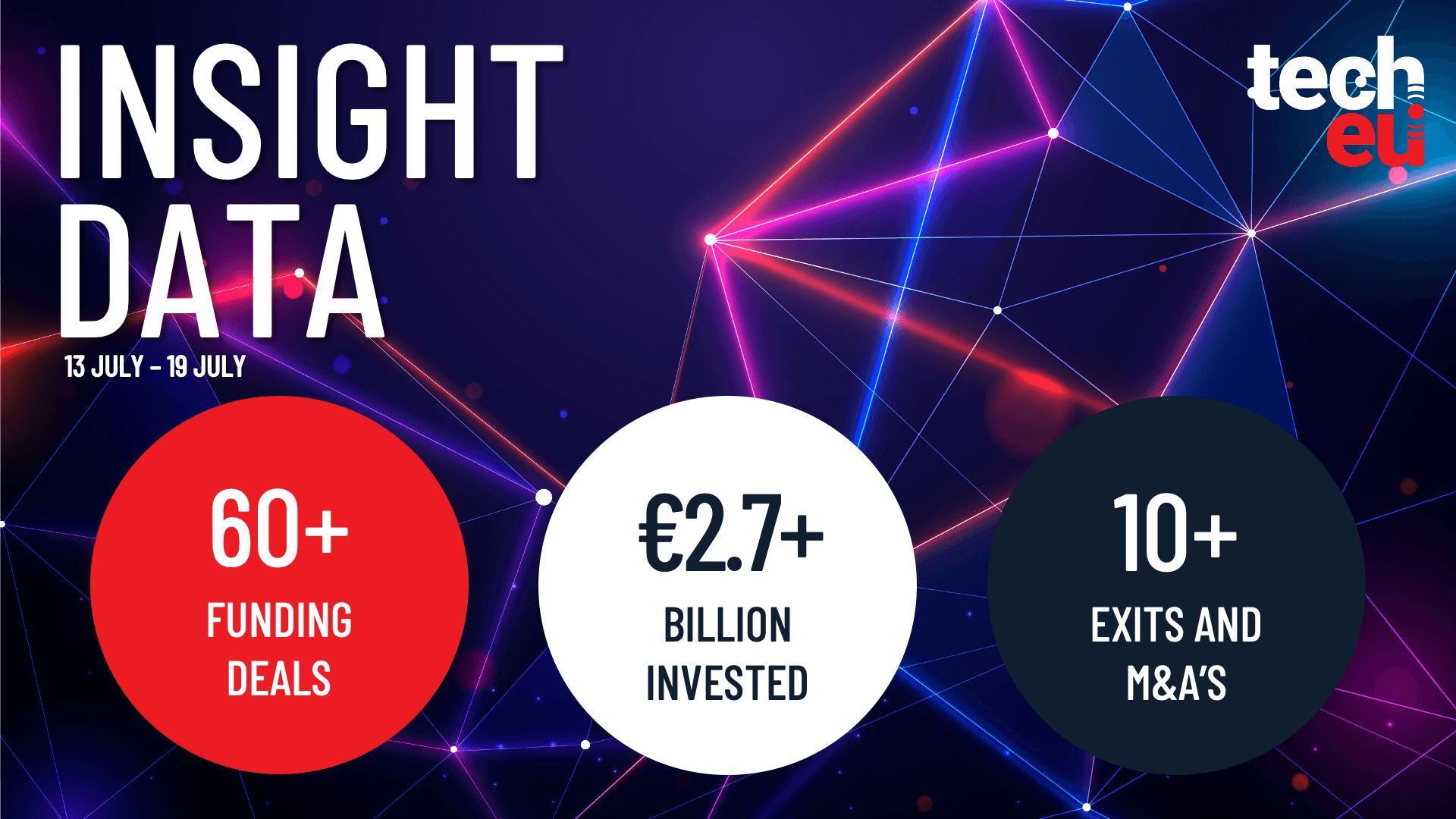
More than 60 tech funding deals worth over €2.7 billion were tracked in Europe last week, with artificial intelligence, healthtech, and software being the top industries. Germany, Sweden, and the UK led the countries with the most funding. The Tech.eu Funding Explorer provides deeper insights into funding data, investor activity, and market trends.

This week, Helsing secured $1.8B Series E funding at an $18B valuation, while Uber acquired Delivery Hero in a €13B deal and Revolut announced plans to launch a US bank in 2027. These developments highlight significant investments and acquisitions in the European tech industry. The funding landscape is shifting, with notable trends in venture activity, investor moves, and emerging sectors.

Alexandre LeBrun, CEO of AMI Labs, a world model startup co-founded by Yann LeCun, is taking a firm stance against using the terms 'AGI' and 'superintelligence' to describe his company's advanced AI. This move challenges the prevailing industry narrative and signals a deliberate shift towards more grounded terminology in AI development.
Microsoft CEO Satya Nadella has issued a stark warning to companies leveraging AI, likening proprietary models from giant AI labs to 'Trojan horses.' This significant statement underscores growing concerns about vendor lock-in, data privacy, and the strategic implications of over-reliance on opaque AI systems.
BatteryLake is a novel platform that standardizes and curates battery aging data, enabling advanced health management and benchmarking. This innovation has significant implications for the AI industry, developers, and businesses. By providing a governed data lakehouse, BatteryLake turns raw public battery data into benchmark-ready assets.
LongMedBench is a new benchmark for evaluating medical agents in long-horizon clinical decision-making. It provides a realistic assessment of AI models in medical care, emphasizing longitudinal interactions and multi-session decision-making. This benchmark has significant implications for the development of more accurate and reliable medical AI systems.
Groundbreaking Arxiv research reveals how large language model safety mechanisms are encoded and can be bypassed, introducing novel 'Activation-Guided' adversarial attacks. The study finds safety representations are distributed across model layers, not localized, and proposes a 33x faster attack method, Soft-GCG, offering critical insights for designing more robust AI alignment strategies.

The Free Software Foundation has been fighting web crawlers and botnets for nearly two years, using a tool called reaction to block millions of IPs. The foundation's systems administrator has shared their experience and techniques for identifying and blocking botnet traffic. This approach has significant implications for the AI industry and cybersecurity.

Europe's tech ecosystem is witnessing a significant resurgence, with over €2.8 billion in funding deals reported this week, signaling a robust venture capital rebound. Major investments into hyperscalers like Nscale, deep tech pioneers such as Proxima Fusion, and strategic AI acquisitions underscore a growing confidence in the continent's innovation capacity and its pivotal role in the future of AI.
MIT Technology Review highlights critical AI architecture elements for IT leaders navigating rapid AI evolution and the rise of agentic systems. The article emphasizes data preparation as a core foundational component, guiding organizations on building stable, integrated AI systems to support future capabilities and mitigate investment risks.
California's ambitious climate program, paying farmers to convert methane from manure into natural gas, is under fire. A recent MIT Technology Review exposé reveals that these lucrative carbon offset schemes may dramatically overstate actual emissions reductions, highlighting critical flaws in policy design and measurement. This situation underscores the urgent need for advanced AI and data analytics to ensure transparency and efficacy in climate action.
New research from arXiv challenges conventional wisdom on AI improvement from feedback, revealing that multi-turn gains often mask true learning. The study highlights that an AI model's ability to effectively *utilize* feedback, rather than merely receiving it, is the critical bottleneck for interactive improvement, especially when compared to unguided self-refinement or simple retries.
A revolutionary method called Poller leverages large language models to evaluate poetry understanding with near-human accuracy, reducing errors by up to 94.55% in specific dimensions. This AI advancement bridges automation and human expertise in literary analysis.
A groundbreaking AI system combines time-series forecasting, anomaly detection, and LLM-driven analysis to deliver actionable energy insights. This end-to-end solution reduces alert noise for facility managers while maintaining high accuracy across 16 real-world scenarios.
MedEvoEval introduces a groundbreaking framework for evaluating AI doctor agents in simulated clinical settings. By tracking cross-episode learning and decision-making, it addresses critical gaps in medical AI evaluation. This tool enables developers to measure knowledge retention, resource allocation, and behavioral adaptation over time.
A groundbreaking study reveals that traditional safety methods for AI agents are fundamentally flawed. Instead of relying on refusal-based content safety, the paper advocates for action alignment and least privilege enforcement to ensure secure, user-intent-driven AI systems.

For two years Europe has been fixated on catching up in the model race, but the real edge may come from how companies integrate AI into their workflows. This article explores why architecture, not sheer size, will define Europe’s AI future.

Researchers introduce a gravitational interpretation of fine-tuning reversion, explaining how AI models can revert to earlier behaviors. This phenomenon is caused by dominant behavioral manifolds created during early training phases. The study provides insights into the safety and stability of AI models, with significant implications for the AI industry.
Get the top AI stories in your inbox once a day, no spam.
Frequently Asked Questions
How often is AI Pulse updated?
New stories are added every couple of hours as they break, so the feed stays current throughout the day.
Where does ThinkSuite source its AI news from?
We pull from 100+ sources, including company blogs, research labs, and established tech publications, then fact check and summarize each story before it goes live.
Can I filter the news by company or topic?
Yes. Use the sidebar filters to narrow stories down by company (OpenAI, Anthropic, Google, and more), industry, or event type like funding and research.
Is AI Pulse free to use?
Yes. AI Pulse is free for anyone who wants to keep up with AI news, no sign up required. The daily newsletter is optional if you want updates in your inbox.