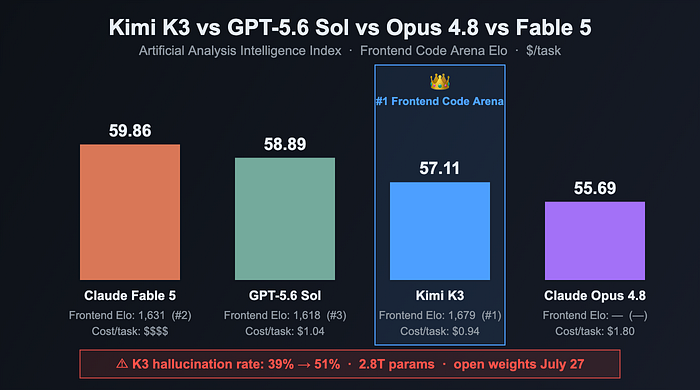
Moonshot AI's Kimi K3, a 2.8-trillion-parameter open-weight model, has surged to the #1 spot on Arena.ai's Frontend Code Arena, outperforming leading models like Claude Fable 5 and GPT-5.6 Sol. This impressive coding prowess is, however, tempered by a significant 51% hallucination rate, raising critical questions about its reliability for advanced agentic pipelines despite its benchmark victories.

A groundbreaking arXiv paper systematically evaluates leading Large Language Models—including GPT-4 Turbo, Claude 3 Opus, and FinGPT—for their efficacy in technical market analysis and algorithmic trading. The research reveals promising results, with top models outperforming benchmarks, yet also highlights critical limitations like numerical hallucination and context window issues that demand further refinement for robust deployment.
Google introduces Neuro-Agentic Control, a novel AI framework that combines LLM-based planning with a Time-Series Foundation Model (TimesFM) to achieve physics-grounded autonomous defense for industrial IoT. This architecture, featuring a "Counterfactual Physics Injection" mechanism, effectively prevents LLM hallucinations, ensuring safe and reliable control over critical security systems in operational technology environments.
Get the top AI stories in your inbox once a day, no spam.
Frequently Asked Questions
How often is AI Pulse updated?
New stories are added every couple of hours as they break, so the feed stays current throughout the day.
Where does ThinkSuite source its AI news from?
We pull from 100+ sources, including company blogs, research labs, and established tech publications, then fact check and summarize each story before it goes live.
Can I filter the news by company or topic?
Yes. Use the sidebar filters to narrow stories down by company (OpenAI, Anthropic, Google, and more), industry, or event type like funding and research.
Is AI Pulse free to use?
Yes. AI Pulse is free for anyone who wants to keep up with AI news, no sign up required. The daily newsletter is optional if you want updates in your inbox.