
Anthropic has launched Claude Opus 5, a groundbreaking AI model that leads the Artificial Analysis Intelligence Index with 61 points, outperforming top competitors like Fable 5 and GPT-5.6 Sol. Excelling in analytical quality and coding, Opus 5 offers superior performance while costing up to half as much as Fable 5 at lower reasoning tiers, signaling a new era of cost-effective, high-performance AI.

Anthropic's new flagship model Claude Opus 5 achieves top scores in coding and knowledge work at half the token price of Fable 5. The model posts impressive results on the ARC-AGI-3 benchmark, outperforming GPT-5.6 Sol. This development has significant implications for the AI industry, offering a more cost-effective solution for businesses and developers.

A new Rust-based Byte-Pair Encoding (BPE) tokenizer, Gigatoken, has been released, demonstrating unprecedented text encoding speeds of up to 24.53 GB/s. This open-source library, developed by Stanford PhD student Marcel Rød, is up to 989x faster than HuggingFace tokenizers and 681x faster than OpenAI's tiktoken, promising a significant boost to Large Language Model (LLM) performance.
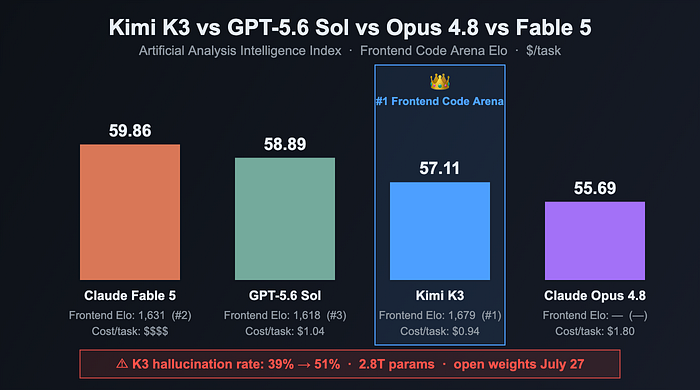
Moonshot AI's Kimi K3, a 2.8-trillion-parameter open-weight model, has surged to the #1 spot on Arena.ai's Frontend Code Arena, outperforming leading models like Claude Fable 5 and GPT-5.6 Sol. This impressive coding prowess is, however, tempered by a significant 51% hallucination rate, raising critical questions about its reliability for advanced agentic pipelines despite its benchmark victories.
OpenAI's latest study explores the necessity of executable world models, simplification, and verification in coding agents, revealing surprising results. The research evaluates four nested Codex-based agents, finding that every agent variant improves with stronger models and greater reasoning effort. The study's findings have significant implications for the development of Artificial General Intelligence (AGI).
The AI landscape is rapidly evolving as three Chinese labs—Moonshot AI, DeepSeek, and Zhipu AI—release powerful, open-weight Mixture-of-Experts (MoE) models. Kimi K3, DeepSeek V4 Pro, and GLM-5.2 are pushing the boundaries of scale and capability, offering trillion-scale parameters and million-token context windows for complex coding and agent workloads, fundamentally shifting the open-source AI leaderboard.
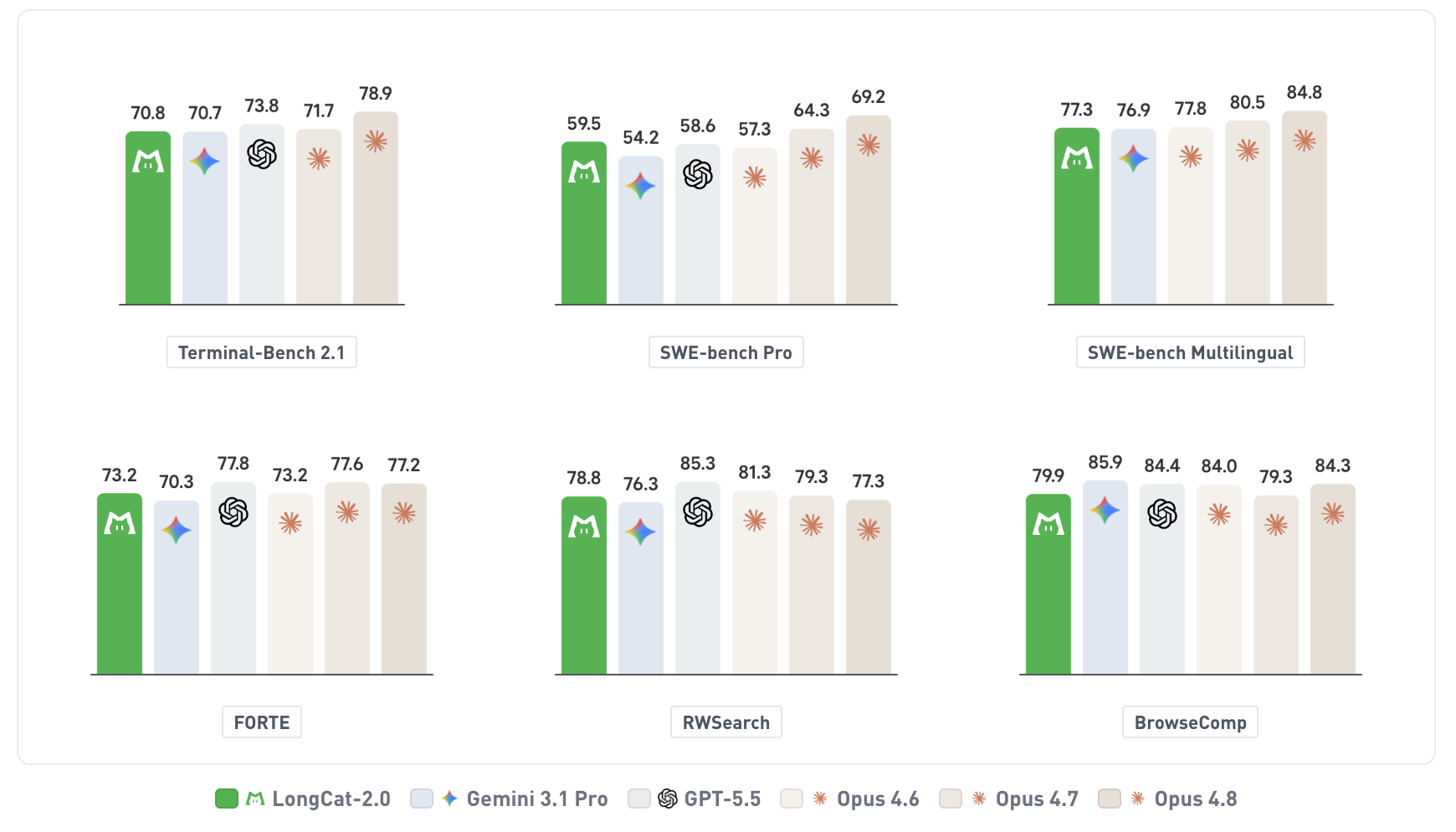
Meituan has released LongCat-2.0, a 1.6T-parameter open MoE model with native 1M context and LongCat Sparse Attention. The model is designed for agentic coding and has been trained on over 35 trillion tokens. It aims to provide reliable and efficient code understanding, generation, and execution inside agent workflows.
Meta researchers achieved 87.69% accuracy in predicting primary ICD-10 diagnosis categories by combining frozen medical LLM representations with multimodal EHR data. Their approach outperformed existing models and demonstrated strong cross-dataset adaptability.
Get the top AI stories in your inbox once a day, no spam.
Frequently Asked Questions
How often is AI Pulse updated?
New stories are added every couple of hours as they break, so the feed stays current throughout the day.
Where does ThinkSuite source its AI news from?
We pull from 100+ sources, including company blogs, research labs, and established tech publications, then fact check and summarize each story before it goes live.
Can I filter the news by company or topic?
Yes. Use the sidebar filters to narrow stories down by company (OpenAI, Anthropic, Google, and more), industry, or event type like funding and research.
Is AI Pulse free to use?
Yes. AI Pulse is free for anyone who wants to keep up with AI news, no sign up required. The daily newsletter is optional if you want updates in your inbox.